
Where Flight Simulation Enthusiasts Gather from Around the World!
AVSIM Library - Search Results

| Category: Combat Flight Simulator 1 and 2 - Aircraft | |
| Doolittle's Raiders North American B-25 Mitchell A/C No. 40-2267 |

|
File Description:
B25-B Mitchell Doolittle's Raiders A/C No. 40-2267, April 18, 1942. Painted over The B24 Guy's B25 Mitchell Overhaul Model. This was mission plane #15. Pilot: Lt. Donald G. Smith, Co-Pilot: Lt. Griffith P. Williams, Navigator/ Bombardier: Lt. Howard A. Sessler, Flight Engineer: Sgt. Edward J. Saylor, Gunner: Lt. Thomas R. White. The bomb group attacked targets in the Tokyo area. The North American B-25B was not designed or intended for aircraft carrier use, but there they were, sixteen highly modified bombers sitting on the deck of the USS Hornet (CV-8). They were modified to carry bombs to Tokyo. The B-25s are launched from their maximum range, and flew over Tokyo, bombing several installations. The bombs did little damage, but managed to damage the Japanese carrier Ryuho while it is in drydock. Many of the planes then head to wherever they can make it, since the fuel will be empty before they reach a friendly airbase. All of the B-25 bombers are forced to bail out or crash land except one. Eleven crews are forced to bail out over China, 3 crash land, and the last landed safely at Vladivostok. The crew that landed in Russia was interned, along with the plane, for a while. The crews were all volunteer, and had no carrier experience, yet all sixteen of the bombers were successful on take-off. Although little physical damage was inflicted on Japan, that day, the Japanese populace was demoralized, as suddenly, the war was brought to their homeland. Texture, and Damage Files included. Note the three windows in both port and starboard bulkheads. By revev. Enjoy!
| Filename: | Doolittles_Raiders_North_American_B25_Mitchell_AC_.zip |
| License: | Freeware |
| Added: | 21st August 2006, 20:50:01 |
| Downloads: | 133 |
| Author: | Evan G. Butterbrodt, The B24 Guy's OH |
| Size: | 1.55 MB |
| Category: Combat Flight Simulator 1 and 2 - Aircraft | |
| B25-B Mitchell Doolittle's Raiders A/C No. 40-2283 for The B24 Guy's OH |
|
File Description:
B25-B Mitchell Doolittle's Raiders A/C No. 40-2283, April 18, 1942. Painted over The B24 Guy's B25 Mitchell Overhaul Model. This was mission plane #5. Pilot: Capt. David M. Jones, Co-Pilot: Lt. Ross R. Wilder, Navigator: Lt. Eugene F. McGurl,Bombardier: Lt. Denver V. Truelove, Flight Engineer/Gunner: Sgt. Joseph W. Manske. The bomb group attacked targets in the Tokyo area. The North American B-25B was not designed or intended for aircraft carrier use, but there they were, sixteen highly modified bombers sitting on the deck of the USS Hornet (CV-8). They were modified to carry bombs to Tokyo. The B-25s are launched from their maximum range, and flew over Tokyo, bombing several installations. The bombs did little damage, but managed to damage the Japanese carrier Ryuho while it is in drydock. Many of the planes then head to wherever they can make it, since the fuel will be empty before they reach a friendly airbase. All of the B-25 bombers are forced to bail out or crash land except one. Eleven crews are forced to bail out over China, 3 crash land, and the last landed safely at Vladivostok. The crew that landed in Russia was interned, along with the plane, for a while. The crews were all volunteer, and had no carrier experience, yet all sixteen of the bombers were successful on take-off. Although little physical damage was inflicted on Japan, that day, the Japanese populace was demoralized, as suddenly, the war was brought to their homeland. Texture, and Damage Files included. Note the three windows in both port and starboard bulkheads. By revev. Enjoy!
| Filename: | B25B_Mitchell_Doolittles_Raiders_AC_No_402283_for_.zip |
| License: | Freeware |
| Added: | 1st August 2006, 20:05:14 |
| Downloads: | 82 |
| Author: | Evan G. Butterbrodt |
| Size: | 1.51 MB |
| Category: Combat Flight Simulator 1 and 2 - Aircraft | |
| B25-B Mitchell Doolittle's Raiders A/C No. 40-2247 for The B24 Guy's OH |
|
File Description:
B25-B Mitchell Doolittle's Raiders A/C No. 40-2247, April 18, 1942. Painted over The B24 Guy's B25 Mitchell Overhaul Model. This was mission plane #13. Pilot: Lt. Edgar E. McElroy, Co-Pilot: Lt. Richard A. Knobloch, Navigator: Lt. Clayton J. Campbell, Bombardier: M/Sgt. Robert C. Bourgeois, Flight Engineer/Gunner: Sgt. Adam R. Williams. The bomb group attacked targets in the Tokyo area. The North American B-25B was not designed or intended for aircraft carrier use, but there they were, sixteen highly modified bombers sitting on the deck of the USS Hornet (CV-8). They were modified to carry bombs to Tokyo. The B-25s are launched from their maximum range, and flew over Tokyo, bombing several installations. The bombs did little damage, but managed to damage the Japanese carrier Ryuho while it is in drydock. Many of the planes then head to wherever they can make it, since the fuel will be empty before they reach a friendly airbase. All of the B-25 bombers are forced to bail out or crash land except one. Eleven crews are forced to bail out over China, 3 crash land, and the last landed safely at Vladivostok. The crew that landed in Russia was interned, along with the plane, for a while. The crews were all volunteer, and had no carrier experience, yet all sixteen of the bombers were successful on take-off. Although little physical damage was inflicted on Japan, that day, the Japanese populace was demoralized, as suddenly, the war was brought to their homeland. Texture, and Damage Files included. Note the three windows in both port and starboard bulkheads. Enjoy!
| Filename: | B25B_Mitchell_Doolittles_Raiders_AC_No_402247_for_.zip |
| License: | Freeware |
| Added: | 2nd August 2006, 00:41:06 |
| Downloads: | 94 |
| Author: | Evan G. Butterbrodt |
| Size: | 1.5 MB |
| Category: Combat Flight Simulator 1 and 2 - Aircraft | |
| B25-B Mitchell Doolittle's Raiders A/C No. 40-2278 for The B24 Guy's OH |
|
File Description:
B25-B Mitchell Doolittle's Raiders A/C No. 40-2278, April 18, 1942. Painted over The B24 Guy's B25 Mitchell Overhaul Model. This was mission plane #12. Pilot: Lt. William M. Bower, Co-Pilot: Lt. Thadd H. Blanton, Navigator: Lt. William R. Pound, Bombardier: T/Sgt. Waldo J. Bither, Flight Engineer/Gunner: S/Sgt. Omer A Duquette. The bomb group attacked targets in the Tokyo area. The North American B-25B was not designed or intended for aircraft carrier use, but there they were, sixteen highly modified bombers sitting on the deck of the USS Hornet (CV-8). They were modified to carry bombs to Tokyo. The B-25s are launched from their maximum range, and flew over Tokyo, bombing several installations. The bombs did little damage, but managed to damage the Japanese carrier Ryuho while it is in drydock. Many of the planes then head to wherever they can make it, since the fuel will be empty before they reach a friendly airbase. All of the B-25 bombers are forced to bail out or crash land except one. Eleven crews are forced to bail out over China, 3 crash land, and the last landed safely at Vladivostok. The crew that landed in Russia was interned, along with the plane, for a while. The crews were all volunteer, and had no carrier experience, yet all sixteen of the bombers were successful on take-off. Although little physical damage was inflicted on Japan, that day, the Japanese populace was demoralized, as suddenly, the war was brought to their homeland. Texture, and Damage Files included. Note the three windows in both port and starboard bulkheads. Enjoy!
| Filename: | B25B_Mitchell_Doolittles_Raiders_AC_No_402278_for_.zip |
| License: | Freeware |
| Added: | 2nd August 2006, 00:41:28 |
| Downloads: | 76 |
| Author: | Evan G. Butterbrodt |
| Size: | 1.53 MB |
| Category: Combat Flight Simulator 1 and 2 - Aircraft | |
| B25-B Mitchell Doolittle's Raiders A/C No. 40-2270 |
|
File Description:
B25-B Mitchell Doolittle's Raiders A/C No. 40-2270, April 18, 1942. Painted over The B24 Guy's B25 Mitchell Overhaul Model. This was mission plane #2. Pilot: Lt. Travis Hoover, Co-Pilot: Lt. William N. Fitzhugh, Navigator: Lt. Carl R. Wildner, Bombardier: Lt. Richard E. Miller, Flight Engineer/Gunner: Sgt. Douglas V. Radney. The bomb group attacked targets in the Tokyo area. The North American B-25B was not designed or intended for aircraft carrier use, but there they were, sixteen highly modified bombers sitting on the deck of the USS Hornet (CV-8). They were modified to carry bombs to Tokyo. The B-25s are launched from their maximum range, and flew over Tokyo, bombing several installations. The bombs did little damage, but managed to damage the Japanese carrier Ryuho while it is in drydock. Many of the planes then head to wherever they can make it, since the fuel will be empty before they reach a friendly airbase. All of the B-25 bombers are forced to bail out or crash land except one. Eleven crews are forced to bail out over China, 3 crash land, and the last landed safely at Vladivostok. The crew that landed in Russia was interned, along with the plane, for a while. The crews were all volunteer, and had no carrier experience, yet all sixteen of the bombers were successful on take-off. Although little physical damage was inflicted on Japan, that day, the Japanese populace was demoralized, as suddenly, the war was brought to their homeland. Texture, and Damage Files included. Note the three windows in both port and starboard bulkheads. By revev. Enjoy!
| Filename: | B25B_Mitchell_Doolittles_Raiders_AC_No_402270.zip |
| License: | Freeware |
| Added: | 1st August 2006, 20:05:03 |
| Downloads: | 83 |
| Author: | Evan G. Butterbrodt |
| Size: | 1.52 MB |
| Category: Combat Flight Simulator 1 and 2 - Aircraft | |
| B25-B Mitchell Doolittle's Raiders A/C No. 40-2292 for The B24 Guy's OH |
|
File Description:
B25-B Mitchell Doolittle's Raiders A/C No. 40-2292, April 18, 1942. Painted over The B24 Guy's B25 Mitchell Overhaul Model. This was mission plane #3. Pilot: Lt. Robert M. Gray,
Co-Pilot: Lt. Jacob E. Manch, Navigator: Lt. Charles J. Ozuk, Jr., Bombardier: Sgt. Aden E. Jones, Flight Engineer/Gunner: Cpl. Leland D. Fakto. The bomb group attacked targets in the Tokyo area. The North American B-25B was not designed or intended for aircraft carrier use, but there they were, sixteen highly modified bombers sitting on the deck of the USS Hornet (CV-8). They were modified to carry bombs to Tokyo. The B-25s are launched from their maximum range, and flew over Tokyo, bombing several installations. The bombs did little damage, but managed to damage the Japanese carrier Ryuho while it is in drydock. Many of the planes then head to wherever they can make it, since the fuel will be empty before they reach a friendly airbase. All of the B-25 bombers are forced to bail out or crash land except one. Eleven crews are forced to bail out over China, 3 crash land, and the last landed safely at Vladivostok. The crew that landed in Russia was interned, along with the plane, for a while. The crews were all volunteer, and had no carrier experience, yet all sixteen of the bombers were successful on take-off. Although little physical damage was inflicted on Japan, that day, the Japanese populace was demoralized, as suddenly, the war was brought to their homeland. Texture, and Damage Files included. Note the three windows in both port and starboard bulkheads. Enjoy!
| Filename: | B25B_Mitchell_Doolittles_Raiders_AC_No_402292_for_.zip |
| License: | Freeware |
| Added: | 2nd August 2006, 00:43:19 |
| Downloads: | 69 |
| Author: | Evan G. Butterbrodt |
| Size: | 1.5 MB |
| Category: X-Plane - Original Aircraft | |
| F-111F Aardvark v1.1 |
|
File Description:
F-111F Aardvark v1.1 for X-Plane 6.40/6.51 - After a prolonged gestation period in which many, many problems had to be identified and fixed, the F-111 turned out to be one of the most effective all-weather interdiction aircraft in the world. Although vilified by some as being an unsafe and dangerous plane, the F-111 series of aircraft established the best safety record of any of the aircraft in the Century Series of fighters with only 77 aircraft being lost in a million flying hours. There was no other aircraft in service with the USAF which can carry out the F-111's mission of precise air strikes over such long ranges in all-weather conditions. Although the aircraft has left USAF service, it still serves with distinction with the Royal Australian Air Force and may very well continue until 2020. The original concept for the F111 was for both a USAF and US Navy version. Weight problems led to cancellation of the Navy version in 1968.
The F111 was the first swing wing fighter, the first with a side by side escape capsule for the operators and the first able to cruise at over mach 1 without after burning. It was also the first bomber with greater than mach 2.5 capability. The F version has a wingspan of 63.0 ft. spread, a length of 73.5 ft. and is powered by two 25100 lb static thrust engines with afterburning. Gross takeoff weight is 100,000 lb., maximum ordinance 31,000 lb and internal fuel 5025 USgal. Range is greater than 2500 nm with internal fuel and service ceiling is above 60000 ft.
| Filename: | F111F_Aardvark_v11.zip |
| License: | Freeware, limited distribution |
| Added: | 12th March 2003, 04:35:23 |
| Downloads: | 1,078 |
| Author: | Robert App |
| Size: | 160.52 KB |
| Category: X-Plane - Original Aircraft | |
| F-111F Aardvark For X-Plane 6.40/6.51 |
|
File Description:
F-111F Aardvark for X-Plane 6.40/6.51 - After a prolonged development period in which many, many problems had to be identified and fixed, the F-111 turned out to be one of the most effective all-weather interdiction aircraft in the world. Although highly critisized by some as being an unsafe and dangerous plane, the F-111 series of aircraft established the best safety record of any of the aircraft in the Century Series of fighters with only 77 aircraft being lost in a million flying hours (that's hours not miles). There was no other aircraft in service with the USAF which could carry out the F-111's mission of precise air strikes over such long ranges in all-weather conditions. Although the aircraft has left USAF service, it still serves with distinction with the Royal Australian Air Force and may very well continue there until 2020. The original concept for the F111 was for both a USAF and US Navy version. Weight problems led to cancellation of the Navy version in 1968.
The F111 was the first swing wing fighter, the first with a side by side escape capsule for the operators and the first able to cruise at over mach 1 without after burning. It was also the first bomber with greater than mach 2.5 capability. The F version has a wingspan of 63.0 ft. spread, a length of 73.5 ft. and is powered by two 25,100 lb static thrust engines with afterburning. Gross takeoff weight is 100,000 lb., maximum ordinance 31,000 lb and internal fuel 5025 USgal. Range is greater than 2500 nm with internal fuel and service ceiling is above 60000 ft.
| Filename: | F111F_Aardvark_For_XPlane_640651.zip |
| License: | Freeware, limited distribution |
| Added: | 26th February 2003, 02:08:23 |
| Downloads: | 486 |
| Author: | Robert App |
| Size: | 169.58 KB |
| Category: Flight Simulator 2004 - Scenery | |
| Bethel PABE in southwest Alaska |
|
Images related to this file:
File Description:
There are four main northwestern Alaska towns which have good airports and are serviced by Alaska Airlines. From these airports local flights connect to nearby villages, "nearby" in Alaska meaning up to 200 miles away. The northernmost is Barrow. Southwest of Barrow is Kotzebue, then Nome, and the furthest south is this one, Bethel. The town of Bethel has a population of just over 6,000 and is 50 miles from the sea on the Kuskowim River, that splits and forks into many tributaries. Bethel Airport is close to the town and provides the only contact with the rest of Alaska, as there is no connecting highway system. There are scheduled flights by Alaska Airlines, ERA (now called Ravn) and Grant Aviation, plus others such as Ryan Air. There are cargo flights by Everts, Northern, and Lynden, and redistribution onwards to nearby villages by the smaller locally-based planes; all of these are included in the AI. There are two main runways, one just under 6,400 feet and another just under 3,900 feet, both of them aligned 19-1. The third runway is around 1,800 feet and mainly gravel, aligned 11-29. Parking at PABE is on three aprons, the northern for smaller commercial planes of Grant, ERA, Ryan etc, the central for larger planes of Alaska, Northern, Everts, and Lynden, and the southern for a large collection of GA; each apron has further hangars for maintenance companies and smaller operators. There is also another separate apron for the local military and Coastguard. There is not much photographic information available for PABE, and I have never been there; as a result it was impossible to make detailed photographic textures for some of the buildings. However, for most hangars I have made textures of at least the right colour etc based on the information I assembled and if it is green with white trim and side windows then that is how it now appears here. The exceptions are the Alaska Airlines terminal building which has complicated curved elements, and the two military hangars and workshops where I had to settle for an Alaska terminal building from another airport and the same for the military. There are numerous small villages in the vicinity of Bethel, all of them being beside either a river tributary or the coast. There are two Google Earth screenshots to show the villages that are served by the flights from Bethel and that are (mostly) included in the AI. Some of these airfields were not included in FS9 but AI will still operate in and out of Bethel. The smaller area screenshot shows the villages that are close to Bethel, and of these eight I have so far made six and they are included in this post: Napaskiak PKA, Napakiak WNA, Kwethluk KWT, Atmautluak 4A2, Nunapitchuk 16A, and Kasigluk Z09. I will work my way through the rest of the area.
| Filename: | Bethel_PABE_in_southwest_Alaska.zip |
| License: | Freeware, limited distribution |
| Added: | 8th March 2019, 00:37:58 |
| Downloads: | 303 |
| Author: | Roger Wensley |
| Size: | 32.02 MB |
| Category: Flight Simulator X - Original Aircraft | |
| B-2A Spirit Stealth Bomber |
|
Images related to this file:
File Description:
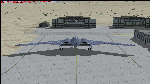
The B-2A Stealth Bomber is the most sophisticated aircraft on the planet. She is essentially a “Flying Wing†platform with no V-Tail, and is controlled by pre-programed flight computers stationed in various positions within the crew cabin and wings. There is one main computer that controls the aircraft, with two redundant back-up computers assigned to it in case of failure. All additional computers are assigned to functions involving flight control, system monitoring, data communications, and radar. Engine and Aerodynamic effects are controlled by these computers which serve several actuators and ailerons, including the spoilerons, which further compensate for the lack of a V-Tail. In theory, and because of these computers, the aircraft is “Stall-Proofâ€. The only way it can stall is if the computers fail. There is no way she can be flown without the computers active. The REAL aircraft does almost everything based on pre-programed data, other than taxi to the runway (although this is also possible to program). Before each flight, the Mission is designed and then assigned to the Mission Flight Box (Portable Computer) which is then carried by the Commander to the aircraft, and the data from the box is “transferred†to the main on-board computers. Because of this, the B-2 cannot be flown until the box is ready for the mission, and pilots cannot simply jump in and fly her, with the exception that the data is transferred via satellite. Everything is pre-planned, and this takes several hours. Once the data is on-board, the taxi can begin. When lined-up on the runway, all the pilot needs to do is push a button or three. Everything else is computer controlled until landing. The aircraft CAN be flown manually with basic data inputs into the main computer systems, but even in that case it is not conventional. If a pilot wants to turn right, he sets the data to turn to a certain degrees of heading. The same with climb and descent, speed increase or decrease. A pilot cannot over-ride the computers in any case, so steep banks, climbs, or descents cannot be forced. There is a lot of space for the two member crew within the cockpit, but there is also a space reserved for one observer. This additional seat is known as “Suicide Position†because there is no ejection seat for that observer. In the event of a mishap, the observer can try to bail-out through the ejection hatches after the pilots, or can try the exit ramp door, or the bomb bay as an exit route. The odds of escape for the observer are very small, but he has a parachute as reassurance. Otherwise, what the crew does during missions is only a guess, since they really don't have to do anything unless an alarm goes off. Since the plane flies so smooth, we can only imagine what sort of things they may dream-up to entertain themselves during a long flight. High altitude flights are conducted at night mainly due to the obvious contrail such a flight will exhibit during the day with such hot engines. The engines are encased in a heat absorbing shield material (still exhaust exists), and the rest of the plane is coated with Radar absorbant material, with the additional low profile effect of the aircraft design itself. If it can be seen by the ground or a fighter, it can be attacked by fighters or the ground. During daytime flight they will stay below the contrail level, and monitor the radar systems in preparations for counter-measures. If a fighter can visually observe them, the fighter may be able to shoot them down with bullets from behind, but not likely with missiles because of the sophisticated counter-measures available. On Radar the aircraft appears the size of a pigeon, until about 8 to 10 miles away, which would be too late to counter from the ground, so most attacks are either done at night or during the day at very low altitude. Upon landing the aircraft is automated down to about 200 feet AGL, when the pilot takes command. All she/he does at this point is allow her to glide down and contact the runway, and retard the engines. Brakes are used to slow, then the computers are turned off, and the pilot can control the throttles, nose gear, and brakes. The Commander watches for obstructions, mainly, and communicates with the tower and ground crew. Everything in this model has been reconfigured to meet realistic standards, without any tricks or flight tuning, and following real world aerodynamic principals and available data, including MOI. The panel requires study before use, but very realistic. The sounds are very authentic. There is no other model offered anywhere that compares to what you have now available in front of you. Please read and study the Readme.txt file within the main folder before attempting to fly this 2.2 Billion Dollar aircraft. Yes, that's correct ... $2,200,000,000 each! The use of this model, and the configuration of such, is designed for educational purposes, and protected by the Free Use Act: (https://www.law.cornell.edu/uscode/text/17/107). The Authors will not approve redistribution for monetary purposes. Original aircraft design by Alphasim; VC Adaptation, panels and gauges by Philippe Wallaert; Sound by Ruggero Osto; REAL WORLD Engine/Aerodynamics, data and effects by Douglas E. Trapp ([email protected]) June 2018
| Filename: | B2A_Spirit_Stealth_Bomber.zip |
| License: | Freeware |
| Added: | 2nd June 2018, 17:16:30 |
| Downloads: | 1,038 |
| Author: | Douglas E. Trapp |
| Size: | 14.81 MB |


© 2001-2026 AVSIM Online
All Rights Reserved
Privacy Policy |