
Where Flight Simulation Enthusiasts Gather from Around the World!
AVSIM Library - Search Results

| Category: Flight Simulator 2004 - Scenery | |
| Gjoa Haven CYHK, on King William Island, Nunavut, Canada, |

|
Images related to this file:
File Description:
Gjoa Haven is a village of 1,200 or so inhabitants at N 68 38 W 95 51 on the southeast corner of King William Island, around 155 miles north of the Arctic Circle. It's Inuit name is Uqsuqtuuq; the Gjoa Haven name was given by the Norwegian explorer Roald Amundsen when he spent two years there from 1903 to 1905 during his exploration of the northwest passage from east to west. His boat was called Gjoa and the cove was named Gjoa Harbour, in Norwegian. The village has been added in this scenery with approximately the right shape; though the coastline with Ultimate Terrain does have the small cove that serves as a harbor the coast shape is wrong. The airfield runway is 4,400 feet of gravel 100 feet wide at 154 feet above sea level. There is no LL100 available, only JetA1, delivered once a year by ship along with all the other requirements of the town. There is also a nearby CAM-B remotely operated defence radar station with its three protective domes. The old terminal building is still there, albeit repainted and spruced up, along with the far larger and newer one alongside it.
One of the screen shots shows Gjoa Haven as it appears for at least 8 months of the year, with snow on the ground and sea ice all around. If you want the ice then download my recent post of All Canada frozen lakes, rivers, and the northern seas, reversible with an untick in the FS scenery library.
| Filename: | Gjoa_Haven_CYHK_on_King_William_Island_Nunavut_Can.zip |
| License: | Freeware, limited distribution |
| Added: | 19th February 2011, 15:42:51 |
| Downloads: | 550 |
| Author: | Roger Wensley |
| Size: | 2.68 MB |
| Category: Flight Simulator X - Aircraft Repaints, Textures and Modifications | |
| Boeing B-17G 91st BG (LL-B) "General Ike" |
|
Images related to this file:
File Description:
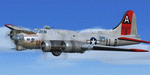
This folder contains a repaint for the A2A WoP2 B-17G in the colors of B-17G 42-97061 LL-B General Ike" of the 401st BS/ 91st BG based in Bassingbourne UK. One of the more well known B-17's of the 91st BG, was originally assigned to the 457th BG, but came to the 91st after only 3 days there, on the 16th March 1944. The aircraft was christened by Genral Eisenhower himself, when he visited the 91st BG on 11 April 1944. The noseart was painted by Cpl. Tony Starcer, with the lettering being done by Cpl. Elvis White. Both artists signed their work, though Cpl White's name later disappeared from the aircraft. Eisenhower liked the painting, but remarked to Cpl Starcer that his eyes were not blue-grey at all. "General Ike" survived the war and returned to Kingman Az, where she was scrapped. On its 65th mission, prop 3 started windmilling and sheared off, hitting the fuselage just below the co-pilots feet, but the only damaged was to the noseart, which was quickly repainted by Cpl Starcer. "General Ike" flew many missions as lead ship, because, as Capt John Davis said after returning from its 21st mission: "She's a mighty sweet plane, not too hot or fast, she moves steadily along. You don't want a fast aircraft for group lead."Ike" gets you over the target and brings you back again", which she did, again and again until the end of the war.
Repaint by Jan Kees Blom, based on the paintkit by A2A.
| Filename: | Boeing_B17G_91st_BG_LLB_General_Ike.zip |
| License: | Freeware |
| Added: | 7th October 2019, 18:19:56 |
| Downloads: | 84 |
| Author: | Jan Kees Blom |
| Size: | 18.8 MB |
| Category: Microsoft Flight Simulator (2020) - Aircraft Repaints, Textures and Modifications | |
| Bleriot XI Britannia |
|
Images related to this file:
File Description:
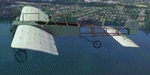
This folder contains a repaint for the Bleriot XI by Wings42 in the colors of Bleriot XI-2 Britannia. The third Bleriot XI imported into New Zealand, it was a two seater presented by the Imperial Air Fleet committee to the New Zealand government. The committee's aim was to promote the development of aviation in the British empire, and the presentation was intended to stimulate military aviation in New Zealand. The aircraft was a proven one, having been flown 347km non-stop from Dover to Cologne by Gustav Hamel in 4 hours 18 minutes on April 17, 1913. The aircraft was dubbed "Britannia' at a ceremony at Hendon on May 22, and Hamel then took former New Zealand Prime Minister Sir Joseph Ward for a short flight. The committee was composed primarily of London businessmen and Sir Joseph was the deputy-Chairman. The aircraft was paid for by public subscription and was valued for insurance purposes at 1400 pounds. The aircraft was disassembled and shipped to New Zealand aboard the Athenic. The aircraft arrived in Wellington on September 29, 1913, where it was discovered that the propeller was not in the shipment. This was soon shipped to New Zealand. In the meantime the aircraft was stored in a purpose built shed at the Buckle street Defence stores. In late 1913 Joseph 'Joe' Hammond had been appointed official Government pilot.
Mr Hammond suggested flying the aircraft to Auckland for display at an Exhibition. However the aircraft was railed north and was assembled in Auckland on January 14, 1914. On January 17, 1914 Mr Hammond made his first flight in the aircraft from the Epsom showgrounds. The following day he completed an hour long flight over Auckland at low level. A flight on the 19th with a journalist as passenger was aborted during takeoff when Hammond found he had no rudder control. Repairs were made and the aircraft flown again on January 24th. Another flight with a passenger then took place. Rather than a member of the media or any of the officials present Hammond chose to take Miss Esme McLalland as passenger. Miss McLalland was a member of the touring Royal Pantomime Company which was performing in Auckland, and the choice failed to impress the officials - Joe Hammonds employment as official pilot was terminated. The aircraft remained on static display for the remainder of the Exhibition and was returned to Wellington at the end of April 1914. Without a pilot (there were several Army Officers training in England - 2nd Lt. A. Piper and 2nd Lt. W. Burn) any official role for the aircraft (and officials did not seem to know what to do with it), it was placed in storage at the Mt Cook barracks in Wellington. Soon after, a report by General Hamilton, the Imperial Inspector of Overseas Forces discouraged further aviation development. With the outbreak of war an offer was made to send the aircraft with the New Zealand Expeditionary Force. It was shipped back to England, departing on the Arawa on October 16. It was unloaded in London on January 15, 1915 and and went from there to Brooklands where it is believed to have been used as a trainer. Repaint by Jan Kees Blom
| Filename: | Bleriot_XI_Britannia.zip |
| License: | Freeware |
| Added: | 8th May 2021, 17:39:55 |
| Downloads: | 17 |
| Author: | Jan Kees Blom |
| Size: | 38.51 MB |
| Category: Flight Simulator 2004 - Original Aircraft | |
| Piaggio P-166CL2 |
|
File Description:
Thanks to Andrew Spring of www.p166.com!!
The fifth of the coming P-166 aircraft series. I'm going to build the whole family of these graceful twins.
This file covers the whole production line of the P-166CL2!!! (Well, just 2...(-:)
The Piaggio P-166A is a light small twin. An Exotic two-engined prop that sold all over the world including America, UK, and Australia. he P-166CL2 was developed to take advantage of the cabin spaciousness of the P-166 series: a new landing gear that retracts under the fuselage into two small blisters lets expand the internal useful area more bakwards between the wings, as there is no central section. This lets the P-166CL2 accomodate 12 poassengers + pilot. The old gear bays at the side of te fuselage were replaced with two large windows that give a strange top-down view for the passenger. Tiptanks are optionally unattachable, as using them plus 12 passengers makes the plane go overweight. Means that the 12 passengers can only be transported on a considerabily short range. Only 2 P-166CL2s were built, due to the low-range caused by the small old-type tiptanks and the unstability of the new landing gear, that gave serious problems while taxiing. The P-166C is dated October '64, and converted to CL2 in 1972. The aircraft is still in production in a slightly modified turboprop version, the P-166D-P1. This model is 760 Kbs with c.a. 23000 polygons in c.a.170 assemblies. Features Clickable Dynamic VC with non-planar throttle quadrant. Detailed internals. Fully compatible with FS 2002 (pro edition)
| Filename: | Piaggio_P166CL2.zip |
| License: | Freeware |
| Added: | 4th April 2004, 18:02:21 |
| Downloads: | 5,617 |
| Author: | Mario Noriega |
| Size: | 7.23 MB |
| Category: Flight Simulator 2004 - Scenery | |
| Beaver Creek CYXQ in Yukon Territory, Canada |
|
Images related to this file:
File Description:
Beaver Creek is located at mile 1202 of the Alaska Highway, just east of the Alaska/Yukon border. The populaton is around 100 and the main employment is with the Border Agency, the White River First Nation, or with local tourist lodges. The airfield is a mile north of the town and close to the Canadian border post, which is included in the scenery. It was built by Jack Stalberg in the 1960's, and I have no further information beyond the fact that he loved to fly. The airport serves as an "airport of entry", though it is restricted in hours of opening and in the size of aircraft that it can handle; up to a maximum of only 15 seats. The single runway is 3,745 feet long and 100 feet wide, gravel, aligned 13-31 in FS9, lit, and with vasi at both ends. Righthand circuits for runway 13. There is a 340 feet threshold displacement to runway 31, which is of course unmarked on a gravel runway. The terminal building was recently reclad; I don't like it, but they didn't consult me. The ai reflects the sort of traffic the airfield gets; ie brief paperwork stopovers for GA or small charter flights into Canada from Alaska, usually in the mornings.I have adjusted the local scenery terrain levels to remove adjacent hills that I believe do not exist in real life but are part of the Northern Canada terrain mesh that I have installed. If you do not have this mesh you may find that the scenery works fine for you without the API flatten that is included here. The airfield is at 2,129 feet ASL.
| Filename: | Beaver_Creek_CYXQ_in_Yukon_Territory_Canada.zip |
| License: | Freeware, limited distribution |
| Added: | 28th January 2019, 06:19:20 |
| Downloads: | 173 |
| Author: | Roger Wensley |
| Size: | 4.68 MB |
| Category: Prepar3D V1-4 - Original Aircraft | |
| Focke Wulf FW-200C series |
|
File Description:
The Focke Wulf FW 200 C series was a long-distance sea reconnaissance aircraft of the German Luftwaffe in World War II. world war. It was developed from the civilian version FW 200 A and B and then by the Luftwaffe used in different versions.
The civilian version has been developed by Hauke ​​Keitel in a very well implemented add-on. he has uploaded this AddOn on FlightSim.com under the name P3D v4 Focke Wulf Fw200A2 as a file fw200a2-1.zip released.
After consultation, Mr. Keitel gave permission to add this add-on and to release the extension under the same terms as its original specifications. I now have done the extension of the Luftwaffe versions as the series using the original FW 200 C0 to FW-200 C8, made as good and close to the original as I can. The models were developed and tested exclusively for P3D 4.5. Possible that you also can use in FSX and other P3D versions. However, I can neither check nor guarantee this. Please note the conditions specified in the original readme file by Mr. Hauke ​​Keitel. They of course are also fully valid for my extensions, since this extension is based on the original and this is absolutely necessary.
The package also includes a version for AI planes.
Please copy and add this to your AI aircraft directory . Airfields appearing in near future will use them for AI traffic.
The supplied extension contains only the files necessary for the supplement and alone it is not executable.
I hope you will enjoy these models.
| Filename: | Focke_Wulf_FW200C_series.zip |
| License: | Freeware |
| Added: | 5th March 2022, 16:46:21 |
| Downloads: | 138 |
| Author: | Klaus Nowak |
| Size: | 180.09 MB |
| Category: Flight Simulator 2004 - Original Aircraft | |
| Piaggio P-166DL3 SEM Patrol Version |
|
File Description:
Thanks to Andrew Spring of www.p166.com!!
The seventh of the coming P-166 aircraft series. I'm going to built the whole family of these graceful twins. The Piaggio P-166A is a light small twin. An Exotic two-engined prop that sold all over the world including America, UK, and Australia. The P-166DL3 is the actual production version of a plane that firt flew in 1957, now with turboprop engines, new avionics, increased fuel capacity, and completly new hydraulic and electric system. Its origin is traced Back to the Piaggio P-136, a light anphibian, which the P-166 keeps the wings, the engines and the tailplanes. The first P-166A flew in November 1957, and the DL3 is dated 1976. The APH version (Aero-PHotograammetric) was originally built featuring a flat bottom with opening holes for cameras and orher devices, planning to use the unit for logistic squads, that never formed. So the APH internal features were generally limited to Military high density transport, paratrooper transport, or Cargo. Units fitted with APH original projected photogrammetric capibilities are very rare. he SEM version can be esily identified by the big sonar under the nose, the FLIR under the left wing and a search light on the right wing. It' a maritime antismuggling patrol aircraft, and it's used by the italian Cost guard and "guardia Di Finanza (Finance Guard). The aircraft waits to be repalced by a new version, the P-166DP-1, with PT-6A engines.
This model is 740 Kbs with c.a. 21000 polygons in c.a.160 assemblies. Features Clickable Dynamic Photoreal VC with non-planar throttle quadrant. New here is the photoreal panel. Detailed internals.
| Filename: | Piaggio_P166DL3_SEM_Patrol_Version.zip |
| License: | Freeware |
| Added: | 19th May 2004, 15:22:01 |
| Downloads: | 7,227 |
| Author: | Mario Noriega |
| Size: | 7.41 MB |
| Category: Prepar3D V1-4 - Aircraft Repaints, Textures and Modifications | |
| Beechcraft Staggerwing (VH-AFP) |
|
Images related to this file:
File Description:
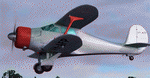
This folder contains a repaint for the Alabeo Beech Staggerwing in the colors of VH-AFP, as it looked in the early sixties. This machine (c/n 357) was originally built as a D17A and registered in the USA as NC20778 to The Armor Institute on 1 November 1939. It took part in their 1940-41 Antarctic Expedition (which I painted as well), following which it was purchased by Connellan Airways in 1941. However, the aircraft was impressed by the RAAF as A39-2 prior to use by Connellan. Post war the aircraft was returned to Connellan where the original 380 hp Jacobs engine was replaced by a 450 hp Pratt & Whitney Wasp Junior, bringing the aircraft up to D17S standard. It was first registered as VH-AFP on 19 March 1947. VH-AFP was withdrawn from service on 6 August 1951, however it was stored and returned to service in 1956, being re-registered on 3 April. The aircraft was once again withdrawn from service in November 1957 and was sold to Tadgell Aviation of Toowomba, Qld and used for crop seeding. It struck a tree and crashed on 22 December 1963 while seeding at Springton, near Dingo, Qld. Sadly the pilot was killed. The burnt out airframe of this Staggerwing was located in April 2007 at the remote crash site and collected by Staggerwing enthusiast Cameron Hanley and trucked to his hangar at Caboolture, Qld where he is rebuilding Beech C17B VH-UXP (for which two repaints are available as well). Repaint by Jan Kees Blom, based on the blank textures by Alabeo.
| Filename: | Beechcraft_Staggerwing_VHAFP.zip |
| License: | Freeware |
| Added: | 14th July 2018, 22:46:19 |
| Downloads: | 88 |
| Author: | Jan Kees Blom |
| Size: | 16.96 MB |
| Category: Flight Simulator 2004 - Original Aircraft | |
| B-26K (A-26A) Counter-Invader |
|
File Description:
In the early 1960's, meeting the need for a "counter-insurgency" aircraft, the USAF chosen On Mark Engineering Company of Van Nuys, California proposed the following major modifications to the already existing B-26 airframe: a complete remanufacture of the fuselage and tail assembly, an enlarged rudder, rebuilt and strengthened wings, re-engining with 2,500 hp P&W R-2800-52W engines, larger, fully reversible propellers with automatic feathering and clipped tips, full dual flight controls, two 165 gallon wing tip tanks, a full compliment of airborne electronics and more. This new aircraft was first delivered to the USAF in June of 1964 under the designation B-26K. Later aircraft had their cowlings revised with the air scoop being relocated further back on the cowl. By April of 1965, all forty B-26K Counter-Invaders had been delivered to the USAF.
For all effects, gauges, and the excellent A-26 sound package by David Copley, the original SOH A-26 Invader is required to be installed before installation of this aircraft. Included in this package: model by Milton Shupe with K model modifications by John Terrell, textures by Russel Smith, Henry William, and John Terrell, 2D panel and gauges by Rich Murray, flight dynamics by Jerry Beckwith and Tom Falley modified by John Terrell, pilot figures by Jan Visser. A special thanks goes out to Milton Shupe who generously provided me the original source model to work with as well as a great amount of help whenever I ran into a tough spot. Also I'd like to thank Cliff Presley for all of his excellent resources he has provided to this project.
| Filename: | B26K_A26A_CounterInvader.zip |
| License: | Freeware |
| Added: | 27th April 2007, 23:33:37 |
| Downloads: | 7,643 |
| Author: | John Terrell |
| Size: | 14.54 MB |
| Category: Flight Simulator X - Original Aircraft | |
| B-2A Spirit Stealth Bomber |
|
Images related to this file:
File Description:
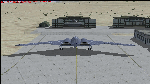
The B-2A Stealth Bomber is the most sophisticated aircraft on the planet. She is essentially a “Flying Wing†platform with no V-Tail, and is controlled by pre-programed flight computers stationed in various positions within the crew cabin and wings. There is one main computer that controls the aircraft, with two redundant back-up computers assigned to it in case of failure. All additional computers are assigned to functions involving flight control, system monitoring, data communications, and radar. Engine and Aerodynamic effects are controlled by these computers which serve several actuators and ailerons, including the spoilerons, which further compensate for the lack of a V-Tail. In theory, and because of these computers, the aircraft is “Stall-Proofâ€. The only way it can stall is if the computers fail. There is no way she can be flown without the computers active. The REAL aircraft does almost everything based on pre-programed data, other than taxi to the runway (although this is also possible to program). Before each flight, the Mission is designed and then assigned to the Mission Flight Box (Portable Computer) which is then carried by the Commander to the aircraft, and the data from the box is “transferred†to the main on-board computers. Because of this, the B-2 cannot be flown until the box is ready for the mission, and pilots cannot simply jump in and fly her, with the exception that the data is transferred via satellite. Everything is pre-planned, and this takes several hours. Once the data is on-board, the taxi can begin. When lined-up on the runway, all the pilot needs to do is push a button or three. Everything else is computer controlled until landing. The aircraft CAN be flown manually with basic data inputs into the main computer systems, but even in that case it is not conventional. If a pilot wants to turn right, he sets the data to turn to a certain degrees of heading. The same with climb and descent, speed increase or decrease. A pilot cannot over-ride the computers in any case, so steep banks, climbs, or descents cannot be forced. There is a lot of space for the two member crew within the cockpit, but there is also a space reserved for one observer. This additional seat is known as “Suicide Position†because there is no ejection seat for that observer. In the event of a mishap, the observer can try to bail-out through the ejection hatches after the pilots, or can try the exit ramp door, or the bomb bay as an exit route. The odds of escape for the observer are very small, but he has a parachute as reassurance. Otherwise, what the crew does during missions is only a guess, since they really don't have to do anything unless an alarm goes off. Since the plane flies so smooth, we can only imagine what sort of things they may dream-up to entertain themselves during a long flight. High altitude flights are conducted at night mainly due to the obvious contrail such a flight will exhibit during the day with such hot engines. The engines are encased in a heat absorbing shield material (still exhaust exists), and the rest of the plane is coated with Radar absorbant material, with the additional low profile effect of the aircraft design itself. If it can be seen by the ground or a fighter, it can be attacked by fighters or the ground. During daytime flight they will stay below the contrail level, and monitor the radar systems in preparations for counter-measures. If a fighter can visually observe them, the fighter may be able to shoot them down with bullets from behind, but not likely with missiles because of the sophisticated counter-measures available. On Radar the aircraft appears the size of a pigeon, until about 8 to 10 miles away, which would be too late to counter from the ground, so most attacks are either done at night or during the day at very low altitude. Upon landing the aircraft is automated down to about 200 feet AGL, when the pilot takes command. All she/he does at this point is allow her to glide down and contact the runway, and retard the engines. Brakes are used to slow, then the computers are turned off, and the pilot can control the throttles, nose gear, and brakes. The Commander watches for obstructions, mainly, and communicates with the tower and ground crew. Everything in this model has been reconfigured to meet realistic standards, without any tricks or flight tuning, and following real world aerodynamic principals and available data, including MOI. The panel requires study before use, but very realistic. The sounds are very authentic. There is no other model offered anywhere that compares to what you have now available in front of you. Please read and study the Readme.txt file within the main folder before attempting to fly this 2.2 Billion Dollar aircraft. Yes, that's correct ... $2,200,000,000 each! The use of this model, and the configuration of such, is designed for educational purposes, and protected by the Free Use Act: (https://www.law.cornell.edu/uscode/text/17/107). The Authors will not approve redistribution for monetary purposes. Original aircraft design by Alphasim; VC Adaptation, panels and gauges by Philippe Wallaert; Sound by Ruggero Osto; REAL WORLD Engine/Aerodynamics, data and effects by Douglas E. Trapp ([email protected]) June 2018
| Filename: | B2A_Spirit_Stealth_Bomber.zip |
| License: | Freeware |
| Added: | 2nd June 2018, 17:16:30 |
| Downloads: | 1,037 |
| Author: | Douglas E. Trapp |
| Size: | 14.81 MB |


© 2001-2026 AVSIM Online
All Rights Reserved
Privacy Policy |