
Where Flight Simulation Enthusiasts Gather from Around the World!
AVSIM Library - Search Results

| Category: Flight Simulator X - Aircraft Repaints, Textures and Modifications | |
| FS2004/FSX/P3D Overseas National - ONA DC-6A 1959 |

|
Images related to this file:
File Description:
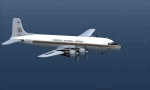
This is a repaint of the Douglas DC-6A (CB17 model) in Overseas National Airways - ONA 1959 colors. The freeware CalClassic DC-6A CB-17 model by Greg Pepper and Tom Gibson is needed for this repaint. ONA was originally formed in 1950 by George Tompkins to undertake overseas contracts on behalf of the USAF. Douglas DC-4s were initially used, with DC-6s joining them later. However, due to underbidding on contracts, ONA declared itself bankrupt on October 29 1963. After this, the airline was extensively re-organized and began operations once again in October 1965, with a fleet of 7 DC-7s. Soon after, in June and July 1966 the airline's first jetliners joined the fleet in the form of DC-8-50Fs. After a 1966 ruling by the CAB, ONA was granted permission to undertake inclusive tour charters, affinity group charters, and single entity charters to transatlantic and Caribbean markets. This was a godsend to the airline and it started to become quite profitable. Over the next decade, the fleet expanded to include: L-188s, DC-8-61/63CFs, DC-8-20/30s, DC-9-30s, and the granddaddy of them all; the DC-10-30CF. During the winter of 1975/76 tragedy struck. Two ONA DC-10s were lost in accidents in the space of two months (November 1975 & January 1976). This was a major blow to the airline and its image. This, coupled with financial difficulties, led the the filing of its second bankruptcy on September 7, 1978. That was the final nail in the coffin. This repaint is on DC-6A N660NA, which joined the airline in 1958, ans was sold to AAXICO in 1961. Textures are 32bit bmp. This repaint was tested on FSX-SE and should work on FSX, P3D v1-3, & FS2004.
| Filename: | FS2004FSXP3D_Overseas_National__ONA_DC6A_1959.zip |
| License: | Freeware |
| Added: | 19th June 2019, 15:55:19 |
| Downloads: | 71 |
| Author: | Ted Giana |
| Size: | 7.57 MB |
| Category: Prepar3D V1-4 - Aircraft Repaints, Textures and Modifications | |
| Alaska Airlines "HONORING THOSE WHO SERVE" livery Operated by Horizon Air E175LR (N651QX) |
|
Images related to this file:
File Description:
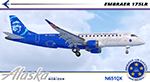
I am proud to present this very special Alaska Airlines Embraer E175LR, operated by Horizon Air, registration N651QX. This E175LR is the third "Honoring Those Who Serve" aircraft in the Alaska Airlines fleet which pays tribute to US military members, veterans, fallen soldiers and their families. Its unique exterior paint scheme, conceived by a small group of Alaska maintenance technicians, was designed to honor those who serve today, and those who served in the past. The design includes; A red stripe and blue aircraft body to incorporate elements of the American flag, the phrase "Honoring Those Who Serve," displayed on the fuselage, symbolic crests representing the Alaska Airlines Fallen Soldier Program on the starboard side rear cargo door and on the port side of the aircraft behind the aft service door, a "Horizon Air Salutes" medallion near the nose of the aircraft on both sides with the five stars, winglets in red, white and blue representing the flag of the United States and five gold stripes on the engine cowls representing the five branches of the U.S. Armed Forces. There is also a Sidney Sheldon quote next to the forward passenger entry door reading “My heroes are those that risk their lives to protect the world and make it a better place.â€
The repainted textures in this package are 32-bit with no mipmaps for best clarity and quality. All of the medallions are hand painted. This is the Version 3 model of the FeelThere Embraer 175. You must own a copy of the Feelthere E-JETS E175 and E195 V3 to enjoy this repaint.
A special thank you to all who serve, who have served and to those who gave their lives in service to this country.
| Filename: | Alaska_Airlines_HONORING_THOSE_WHO_SERVE_livery_Op.zip |
| License: | Freeware, limited distribution |
| Added: | 29th April 2020, 19:09:32 |
| Downloads: | 831 |
| Author: | Jeffrey S. Bryner, FeelThere |
| Size: | 56.71 MB |
| Category: Flight Simulator 2004 - Aircraft Repaints, Textures and Modifications | |
| Classic Delta Air Lines Widget Concorde |
|
Images related to this file:
File Description:

This is a Fictional Repaint of the Great Project Mach 2 Concorde model
in a Classic Delta Air Lines Widget livery.
It is Time for the Widget to Go Super Sonic.
| Filename: | Classic_Delta_Air_Lines_Widget_Concorde.zip |
| License: | Freeware |
| Added: | 20th May 2016, 16:44:34 |
| Downloads: | 236 |
| Author: | Painted By:Todd Manbeck , Created by:FSFRANCE Project Mach 2 , Base Files Hosted by Historic Jetliners Group |
| Size: | 12.28 MB |
| Category: Flight Simulator X - Scenery | |
| RAF East Moor |
|
File Description:
RAF East Moor was opened in 1942 and was originally a 4 Group facility and first hosted No. 158 Squadron RAF which had moved from RAF Driffield on 6 June 1942. The squadron flew the Handley Page Halifax Mk. II with detachments at RAF Beaulieu and RAF Manston before moving to RAF Rufforth on 6 November 1942.
Royal Canadian Air Force use
The first squadron was No. 429 Squadron RCAF which formed at the airfield on 7 November 1942 initially only flying the Vickers Wellington Mk.III until January 1943 when the Wellington Mk. X was added. The squadron left on 13 August 1943 going to RAF Leeming where the unit re-equipped with Halifaxes. On 19 September 1943 the next squadron arrived being 432 Squadron which initially used the Avro Lancaster Mk.II before being re-equipped with the Halifax Mk. III in February 1944 and the Mk. VII Halifax in July 1944. The squadron disbanded on 15 May 1945 at the airfield.
The last Canadian squadron to use the airfield was 415 Squadron which flew the Halifax III from 26 July 1944. The unit inherited the additional Mk.VII versions during March 1945 but disbanded shortly after on 15 May 1945 at the airfield.
Royal Air Force use
Not long after the last Canadian squadron disbanded the airfield was handed back to the Royal Air Force (RAF). The first RAF unit to use the airfield was No. 54 Operational Training Unit (OTU) which had moved in during November 1945 flying the de Havilland Mosquito. By May 1946 No. 288 Squadron RAF joined with their Supermarine Spitfire IX's and their Vultee Vengeance Mk. IV's with a detachment at RAF Acklington. The squadron disbanded on 15 June 1946. No. 54 OTU stayed until June 1946 when the unit moved to RAF Leeming but a detachment stayed until 15 November 1946.
The airfield closed to flying in November 1946. Most of the buildings were taken down and the land has reverted largely to agricultural use.
| Filename: | RAF_East_Moor.zip |
| License: | Freeware |
| Added: | 14th March 2017, 19:41:08 |
| Downloads: | 128 |
| Author: | Terry Boissel |
| Size: | 154.38 KB |
| Category: Flight Simulator X - Scenery | |
| RAF Tholthorpe |
|
File Description:
RAF Tholthorpe opened in the late 1930s as a grass airfield, and operated as a sub-station of RAF Linton-on-Ouse.
From August 1940 to December 1940, Tholthorpe was a landing field for Whitley bombers of No. 58 Squadron RAF and No. 51 Squadron RAF based at Linton. From January 1941 to June 1943, Tholthorpe underwent maintenance to upgrade to Class A standards, with three intersecting concrete runways.
RAF Tholthorpe was assigned to No. 6 Group RCAF in June 1943. RCAF squadrons stationed here included No. 434 Squadron "Bluenose", 431 Squadron "Iroquois", 420 Squadron "Snowy Owl", and 425 Squadron "Alouette".
No. 434 Squadron, flying Halifax bombers, was formed and headquartered at Tholthorpe airfield from June 1943 until the squadron was moved to Croft. In July 1943, 431 Squadron moved to Tholthorpe airfield from Burn. It was later moved to Croft airfield as well. Not only were the operational squadrons quartered here, also their service echelons, - respectively Nos. 9431 and 9434 Service Echelon - which were formed from the ground crew of nos. 431 and 434 Squadron on 3 November 1943 and who moved with their squadrons on to Croft in December 1943.
In December 1943 No. 420 and No. 425 Squadrons (together with their service echelons, nos. 9420 and 9425 Service Echelon were moved to Tholthorpe airfield from Dalton and Dishforth respectively. These squadrons had returned from service with Wellingtons in North Africa, and it took them several weeks to work up on the newly acquired Halifax bombers. They were therefore unable to fly their first raids from Tholthorpe until mid-February 1944.
No. 420 Squadron flew 160 operations from Tholthorpe airfield and lost 25 Halifax’s. No. 425 squadron flew 162 operations from Tholthorpe airfield and lost 28 Halifax’s. In all, 119 Halifax bombers were lost from Tholthorpe. In April and May 1945 nos. 420 and 425 Squadron converted to Avro Lancaster’s, which they took with them when they left for RCAF Debert, Nova Scotia, Canada in June 1945.
The station closed in June 1945.
| Filename: | RAF_Tholthorpe.zip |
| License: | Freeware |
| Added: | 9th May 2017, 20:41:48 |
| Downloads: | 138 |
| Author: | Terry Boissel |
| Size: | 4.63 MB |
| Category: Prepar3D V1-4 - Aircraft Repaints, Textures and Modifications | |
| North American P-51D 3rd ACG (C) 'Bad Angel' |
|
Images related to this file:
File Description:
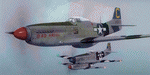
This folder contains a second repaint for the A2A WoP3 P-51D Mustang, in the colors of P-51D-20 44-63272 “Bad Angelâ€, flown by Lt. Louis Curdes of the 4th Fighter Squadron, 3rd Air Commando Group. He is one of a very few American pilots to have kills against each of the three major Axis powers, and I believe the only US pilot to display an American flag among his victory markings.
While serving in the MTO, Curdes downed several Fw-190’s, and one of the Macchi C.202’s he downed is now on display at the National Air & Space Museum in Washington DC. He was shot down over Italy and spent a short time as a POW before escaping. Because he was an escaped POW, he couldn’t fly again against the Germans for security reasons.
He was transferred to the PTO, and on February 10, 1945, during a sweep to Bataan Island, he saw a P-51 pilot parachute into the sea. Curdes circled around him to pinpoint his position to rescuers. While circling, he saw a USAAF C-47 that was preparing to land on the Japanese-held strip on Batan. The C-47 crew didn’t respond to repeated attempts at radio contact and, unable to shepherd the C-47 to safety, Curdes saw only two possibilities – first that it was a Japanese plane bearing false US markings (the DC-3 having been built under licence in Japan prior to the war), or it was a US plane whose crew was unaware the field had fallen to the Japanese. He therefore carefully shot out both engines, causing the plane to land in the sea. All 13 people on board the C-47 were rescued – and they were indeed Americans, including a nurse Curdes had previously dated. Repaint by Jan Kees Blom.
| Filename: | North_American_P51D_3rd_ACG_C_Bad_Angel.zip |
| License: | Freeware |
| Added: | 3rd November 2018, 23:18:24 |
| Downloads: | 49 |
| Author: | Jan Kees Blom |
| Size: | 6.11 MB |
| Category: Flight Simulator X - Aircraft Repaints, Textures and Modifications | |
| Boeing B-17G 91st BG (OR-L) "Blue Dreams" |
|
Images related to this file:
File Description:
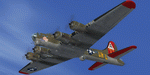
This folder contains a repaint for the A2A WoP2 B-17G in the colors of B-17G-10-DL 42-37761 OR-L "Blue Dreams" of the 323rd BS/ 91st BG, based in Bassingbourne, UK. "Blue Dreams" was assigned to Captain Ken McFarland and his crew, and was painted by Corporal Tony Starcer, with the december pin-up by Alberto varga. When the crew found out that their captain's wife was pregnant, they had Starcer paint a stork and baby below the pilots window (without McFarlane knowing), adding the name 'Mona Gail'after the birth of his daughter. The aircraft would go on to complete 29 missions with the group, before being written off due to an unfortunate oversight by another crew. Shortly after taking off for a flight to Berlin, on the 6th of March 1944, the pilot, Lt Walter Wilkinson, noticed fuel streaming from the starboard wing. He decided to land immediately, in the hope of quickly solving the problem and rejoining the mission. The nearest airfield was the 355th FG's base at Steeple Morden, close to Bassingbourne, and he decided to land there. He lined up with the runway and slowly descended the heavily laden bomber, going for a smooth as possible landing. What came was different, since the crew had forgotten to lower the landing gear, and "Blue Dreams" screeched of the runway and into the grass. The crew evacuated the wrecked aircraft as quickly as they could, but fortunately, the bombs in the bomb-bay did not explode. "Blue Dreams" would not fly again, and was salvaged the following day. The subsequent accident report revealed that the pilot had flown 8 exhaustive missions in the previous two weeks. This time nobody was hurt, but it would be a different story 10 months later, when another 91st B-17 forcelanded at Steeple Morden...
Repaint by Jan Kees Blom, based on the A2A paintkit.
| Filename: | Boeing_B17G_91st_BG_ORL_Blue_Dreams.zip |
| License: | Freeware |
| Added: | 7th October 2019, 18:19:18 |
| Downloads: | 101 |
| Author: | Jan Kees Blom |
| Size: | 17.66 MB |
| Category: Flight Simulator 2004 - Scenery | |
| Iles de la Madeleine CYGR in Quebec Canada |
|
Images related to this file:
File Description:
The Iles de la Madeleine are a group of spit islands linked by bridges in the Gulf of St Lawrence. They are east of New Brunswick, north of Cape Breton Island, west of the Island of Newfoundland, and south of the mainland coast of Quebec. On a southwest to northeast axis they are 40 miles in length and the airport CYGR is pretty much at the midpoint of the southern line of islands. Take a look at the overhead from FS9 to see what I mean. CYGR has two runways, one is aligned 08-26 and is just under 4,400 feet long and 150 feet wide with lighting and PAPI at both ends. The second is aligned 16-34 and is 3,600 feet long and 150 feet wide, without lights or PAPI. Both are asphalt. The apron is not huge, and a newish (in 2010) hangar was built with separate access to the 16-34 runway. There are daily flights by Air Canada and Pascan Aviation included in the AI. The AI also includes some boats and a ferry, and I first used these with my Dutch Harbor scenery, so if you have that already.... This scenery also includes Cindy Hook, a small boat harbour just 2 miles southwest of the airport, and the larger harbour at Cap aux Meules a further 3 miles away that accommodates the daily ferry trips, along with fishing boats etc. Also included here is a further addition to the Homer PAHO scenery in the shape of a boat that is included in the Homer Spit harbour. Just add the contents of the scenery folder to the Homer scenery folder of your Homer installation, and the texture folder contents to the Homer texture folder. This is hopefully the last PAHO addition, and again apologies. If you find an error email me please, and note that my email address has been changed to rogwens at Gmail dot com.
| Filename: | Iles_de_la_Madeleine_CYGR_in_Quebec_Canada.zip |
| License: | Freeware, limited distribution |
| Added: | 28th July 2021, 17:02:18 |
| Downloads: | 188 |
| Author: | Roger Wensley |
| Size: | 26.7 MB |
| Category: Flight Simulator X - Aircraft Repaints, Textures and Modifications | |
| FS2004/FSX/P3D Project Airbus Himalaya Airlines 9N-ALV Airbus A320-214(WL) |
|
Images related to this file:
File Description:

(TEXTURES ONLY)
(ONLY TESTED IN FSX: STEAM EDITION)
This was requested by Ney Costa on the Official Project Airbus Facebook Group.
This was my attempt on making my own lightmaps for the logo lights, and honestly, it came out better than I expected! I used Kevin Chung's photos of 9N-ALV from Flickr to copy it.
I also changed the wing inspection lights from the Incandescent Halogen Lightbulbs to the Light Emitting Diode, or LED Lightbulbs to match the aircraft.
A320s from the 2010s and 2020s usually arrive with these updated lights. Not just the NEO, LR and XLR planes but also the normal CEO planes as well.
My first attempt on doing the LED Wing Inspection Lightbulbs were bad as I usually just copy and paste them from A321 photos from Flickr, I needed them for my Royal Air Philippines NNJT A321PCF Livery Pack, which I will try to soon complete as it will include RP-C9867, RP-C9866, and RP-C9869.
So, my second attempt on finding photos was with this livery, and it just looks much better than the 2nd attempt. I even included both the Incandescent Lights and LED Lights in the Decal just in case someone wants to use it. It is from Kevin Chung's photos, which I greatly appreciated!!!
Another thing is that this is my 2nd attempt on doing the livery, as my first was actually done all the way back in late 2023 / early 2024. But unfortunately, while it was completed, it was from my old laptop, which is now broken. A lot of those other liveries that I made but never released were there as well. I could try re-creating them though, like the Sun Country A320 Fictional Livery I made months ago when I also originally did it back in 2024.
| Filename: | FS2004FSXP3D_Project_Airbus_Himalaya_Airlines_9NAL.zip |
| License: | Freeware |
| Added: | 12th July 2026, 14:17:33 |
| Downloads: | 68 |
| Author: | Ryubunao |
| Size: | 48.17 MB |
| Category: Flight Simulator 2004 - Original Aircraft | |
| Ansaldo S.V.A.-5 (V.01) |
|
Images related to this file:
File Description:
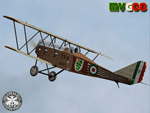
One of the faster airplane of WWI thanks to an innovative design, the S.V.A. was the first airplane conceived and built entirely in Italy. The initials "S.V.A." stand for the names of Savoia and Verduzio, the two engineers that designed it, and of Ansaldo, the firm that built over 2000 of them starting from 1917. The Ansaldo S.V.A. was an entire family of Italian reconnaissance biplane aircraft of World War I and the decade after. Originally conceived as a fighter, the S.V.A. was found inadequate for that role. Nevertheless, its impressive speed, range and operational ceiling made it an excellent reconnaissance aircraft and even light bomber.
The S.V.A. became legendary among pilots for some of its memorable flights; first, above all, the one over Vienna: this flight was an epic action performed by Italian poet and nationalist patriot Gabriele D'Annunzio on 9th August 1918. After the war, thanks to the strong determination of Arturo Ferrarin and Guido Masiero( the pilots), two S.V.A.9s (the two seater version of the S.V.A.-5) flew for 18000Km from Rome to Tokyo (14th February / 31st May 1920). Another S.V.A., piloted by Antonio Locatelli, first flew alone across the Andes (30th July 1919).
Production of the aircraft continued well after the war, with the final examples delivered in 1928. In 1919 some S.V.A.s were used in airmail routes by "Gruppo Sperimentale Comunicazioni Aeree", a group formed by the Italian Army in order to prove the feasibility of commercial air services. The Regia Aeronautica (Royal Italian Air Force, since 1923) employed the S.V.A. in operational units in Italy and North Africa (Lybia) as well as for pilot training. Many war-surplus planes were employed by commercial flying schools.
Complete aircraft, 5 Different Hi-Res GMax models (5 different versions, three S.V.A.-5 and two S.V.A.-9), features the usual moving parts, such as all flight controls. Five different liveries (three WWI and two post-war). VC and 2D Panel. Models, panels and paints by Manuele Villa, Flight dynamics, Handling notes and tutorials by FSAviator.
September 2008. Installation instructions included.
| Filename: | Ansaldo_SVA5_V01.zip |
| License: | Freeware |
| Added: | 6th May 2010, 08:49:53 |
| Downloads: | 3,207 |
| Author: | Manuele Villa |
| Size: | 40.55 MB |


© 2001-2026 AVSIM Online
All Rights Reserved
Privacy Policy |