
Where Flight Simulation Enthusiasts Gather from Around the World!
AVSIM Library - Search Results

| Category: Flight Simulator X - Scenery | |
| Aran Islands Airports and Connemara Regional Airport |

|
File Description:
Aran Island Airports and Connemara Regional with Flightplans FSX.
FSX compatible only.
Includes: Fictional Flightplans for the three Aer Arann Islands BN2s, Changes to Parking in all four airports, Tower Frequency For All Four Airports, Objects Including Tractors, Hangers and Small Terminals.
Created using ADEX v01.47.07
Created from default scenery.
| Filename: | Aran_Islands_Airports_and_Connemara_Regional_Airpo.zip |
| License: | Freeware |
| Added: | 27th November 2010, 20:37:25 |
| Downloads: | 1,620 |
| Author: | Padraic O hEithir |
| Size: | 12.72 MB |
| Category: Flight Simulator X - Original Aircraft | |
| Douglas DC-4 and C-54, V3.0 |
|
Images related to this file:
File Description:
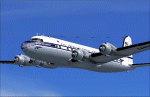
FSX Douglas DC-4 and C-54 V3.0. This base package includes 24 colour schemes covering the period 1942-2006, including Pan American, USAAF, SAS, Loftleidir, Buffalo Airways and many others. Version 3.0 model for FSX, with improved flight dynamics, more accurate panel and improved detail in the virtual cockpit. Model by Jens B. Kristensen. For FSX only, FS2004 users should download DC4_V30.zip instead.
| Filename: | Douglas_DC4_and_C54_V30.zip |
| License: | Freeware |
| Added: | 19th December 2010, 01:08:50 |
| Downloads: | 5,744 |
| Author: | Jens B. Kristensen |
| Size: | 33.35 MB |
| Category: Flight Simulator X - Miscellaneous Files | |
| Default Robinson 22 - Reworked and added views |
|
Images related to this file:
File Description:
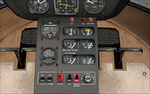
Reworked and additional views ( defined by camera definitions in the sim.cfg file in this particular case ) for the beautiful default ( Microsoft ) Robinson R22.
10 cameras pointing at the aircraft and 3 additional cameras inside.
See Read me.txt file for very easy installation procedures.
Also included is a text file that contains the new camera definitions. Enjoy !
| Filename: | Default_Robinson_22__Reworked_and_added_views.zip |
| License: | Freeware |
| Added: | 23rd December 2010, 17:29:31 |
| Downloads: | 341 |
| Author: | Marc Renaud |
| Size: | 22.91 KB |
| Category: Flight Simulator X - Aircraft Repaints, Textures and Modifications | |
| Default Mooney Bravo - Reworked and added views |
|
Images related to this file:
File Description:
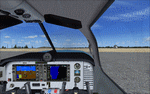
Additionnal views ( defined by camera definitions in the aircraft.cfg file ) for
the beautiful Mooney by Microsoft. 4 cameras pointing at the aircraft and a total of 6 views in VC mode.
See Read me.txt file for very easy installation procedures.
Also included is a text file that contains the new camera definitions. Enjoy !
| Filename: | Default_Mooney_Bravo__Reworked_and_added_views.zip |
| License: | Freeware |
| Added: | 3rd January 2011, 23:15:02 |
| Downloads: | 295 |
| Author: | Marc Renaud |
| Size: | 2.97 KB |
| Category: Flight Simulator X - Aircraft Repaints, Textures and Modifications | |
| Boeing 727-100 and 727-200 - Fix |
|
File Description:
Adds a missing effect file texture for my B727-100 and B727-200 package (tom7271.zip). Sorry.
| Filename: | Boeing_727100_and_727200__Fix.zip |
| License: | Freeware |
| Added: | 6th February 2011, 22:51:52 |
| Downloads: | 10,926 |
| Author: | Thomas Ruth |
| Size: | 2.18 KB |
| Category: Flight Simulator X - Aircraft Repaints, Textures and Modifications | |
| Bombardier CRJ 700 Reworked and added views |
|
Images related to this file:
File Description:

Original views reworked and additionnal views ( defined by camera definitions in the aircraft.cfg file ) for the beautiful Bombardier CRJ 700 by Microsoft.
10 cameras pointing at the aircraft. No new views inside but reworked.
See Read me.txt file for very easy installation procedures.
Also included is a text file that contains the new camera definitions and a pdf file that presents tables telling your where you can find the various "camera definitions projects" I have posted until now.
| Filename: | Bombardier_CRJ_700_Reworked_and_added_views.zip |
| License: | Freeware |
| Added: | 21st February 2011, 15:26:30 |
| Downloads: | 354 |
| Author: | Marc Renaud |
| Size: | 83.21 KB |
| Category: Flight Simulator 2004 - Aircraft Repaints, Textures and Modifications | |
| Boeing 757 El Al and Sun D'or |
|
File Description:
These are paints that are matching the CS757. In the package there are paints of the EL AL Israel Airlines aircraft and the sister airline Sun D'or. Enjoy!!
| Filename: | Boeing_757_El_Al_and__Sun__Dor.zip |
| License: | Freeware |
| Added: | 27th February 2011, 23:46:59 |
| Downloads: | 253 |
| Author: | Omri Ben-Shahar |
| Size: | 104.2 MB |
| Category: Flight Simulator X - Scenery Design | |
| Duplicate Object Finder for FS9 and FSX |
|
Images related to this file:
File Description:
Duplicate Object Finder (DOF) is a simple tool designed to find multiple copies of FS9 or FSX scenery
objects. It does this by searching through your FS installation using the Scenery List and collecting
information about objects. The results are displayed in a list for information. It is also possible to
print this list.
| Filename: | Duplicate_Object_Finder_for_FS9_and_FSX.zip |
| License: | Freeware, limited distribution |
| Added: | 20th March 2011, 20:44:56 |
| Downloads: | 2,373 |
| Author: | Jon Masterson - ScruffyDuck Software |
| Size: | 2.9 MB |
| Category: Flight Simulator X - Miscellaneous Files | |
| Grumman Goose G21A - Reworked and new views |
|
Images related to this file:
File Description:
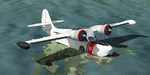
Some original views reworked and additionnal views ( defined by camera definitions in the aircraft.cfg file ) for
the beautiful Grumman Goose G21A by Microsoft.
6 cameras pointing at the aircraft and 1 additionnal view inside the aircraft.
See Read me.txt file for very easy installation procedures.
Also included is a text file that contains the new camera definitions. Enjoy !
| Filename: | Grumman_Goose_G21A__Reworked_and_new_views.zip |
| License: | Freeware |
| Added: | 3rd April 2011, 04:32:57 |
| Downloads: | 538 |
| Author: | Marc Renaud |
| Size: | 110.45 KB |
| Category: Flight Simulator X - Aircraft Repaints, Textures and Modifications | |
| Austrian Airlines and Air Rhodesia Vickers Viscount |
|
Images related to this file:
File Description:
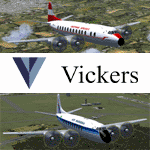
This file contains textures for Austrian Airlines and Air Rhodesia paints. You need to have Jens Kristensen's freeware Viscount installed to use them. Textures also work in FS9; follow the additional instructions in the READ ME.
| Filename: | Austrian_Airlines_and_Air_Rhodesia_Vickers_Viscoun.zip |
| License: | Freeware |
| Added: | 6th April 2011, 01:05:53 |
| Downloads: | 439 |
| Author: | Henry Douglas/Jens Kristensen |
| Size: | 3.23 MB |


© 2001-2026 AVSIM Online
All Rights Reserved
Privacy Policy |