
Where Flight Simulation Enthusiasts Gather from Around the World!
AVSIM Library - Search Results

| Category: Flight Simulator X - AFCAD Files | |
| RPLC - Diosdado Macapagal International Clark International, Philippines |

|
File Description:
This Afcad/AFD for RPLC - Diosdad Macapagal International Airport (previously Clark International Airport and Clark AFB) in Angeles City, Pampanga, Philippines was made with ADE V1.37 and is for the default RPLC airport in FSX.
Diosdado Macapagal International Airport is currently a significant low cost carrier and UPS hub for the Philippines and is under development - ultimately intended to replace Ninoy Aquino Airport, Manila (RPLL) as the Premier Gateway to the Philippines. Domestic traffic is currently limited to Cebu Pacific and South East Asian Airlines. The airport handles international traffic - AirAsia, Asiana, Tiger Airways, Hong Kong Express, Hong Kong Airlines and Transglobal - including their recently launched flights to Dhaka and Fujairah - as well as international flights for Asian Spirit to and from Seoul. Cargo use includes a very significant UPS hub, Yangtze River Express, Transglobal and Pacific East Asia Cargo Airlines. Philippine Air Force C-130's are also frequent visitors.
Aprons and taxiways have been changed as needed, additional cargo and airline specific maintenance aprons added, taxiways surfaced correctly, gates and parking spaces coded for airlines and aircraft types using the airport. Many buildings have been changed to be more representative of the real thing. The default airport lacks coding and sees little of the actual traffic coming to RPLC. Use of this file increases traffic and places them where they should park. Tested with WOAI, MAIW's Exotic Alberts Package Philippines Part 1 and custom AI.
| Filename: | RPLC__Diosdado_Macapagal_International_Clark_Inter.zip |
| License: | Freeware |
| Added: | 24th August 2008, 01:18:46 |
| Downloads: | 1,944 |
| Author: | Matthew Brooks |
| Size: | 15.34 KB |
| Category: Flight Simulator X - Original Aircraft | |
| Boeing 737-800 Starter Package v1.0.0 |
|
File Description:
This is an upgrade package for the default Boeing 737-800. I compiled this package with new simmers in mind. This package has an advanced virtual cockpit that includes switches for LCD, EICAS, PFD, MFT, autobrake, pilot windows, cabin lights and GPWS. It also includes working windshield wipers with rain effects, upgraded virtual cockpit textures, a realistic Flight Management Computer and custom GPWS and cabin announcement sounds. I've included 11 high-quality liveries for Air Berlin, Air France, AirTran Airways, American Airlines, British Airways, Delta Airlines, Lufthansa, Pan American World Airways, Quantas, United Airlines and US Airways. I'll add more in future releases. I haven't asked permission from any of the original developers of these add-ons to include their work in this package. If I've used your work and you're upset about it, please reach out to me and I'll take care of it promptly. This package uses Advanced 737-800 VC by Alejandro Rojas Lucena, Upgraded 737-800 VC Textures by Enrique Cornejo, Honeywell FMC by Garrett Smith, Boeing Callouts by Jimmy Foong and EDO Sounds by Edoardo Ammannati. I collected the liveries from multiple different packages. I'm not sure who the original authors are. If you're the author of one of these liveries, let me know so that I can give you credit. All of the copyrights for these add-ons belong to their rightful developer(s). I've just compiled the best that I could find.
| Filename: | Boeing_737800_Starter_Package_v100.zip |
| License: | Freeware |
| Added: | 11th June 2018, 17:18:45 |
| Downloads: | 6,081 |
| Author: | Austin Melton |
| Size: | 90.53 MB |
| Category: Flight Simulator 2004 - Helicopters | |
| Bell 429 Base Pack |
|
Images related to this file:
File Description:
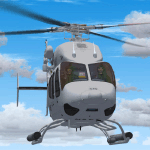
A large number of different models based on the real rotorcraft and with at least one different livery per model (32 in total) / A great variety of animations: All doors (including the clamshell in the rear of the ship). Main rotor, which is fully articulated. Show/hide flight controls feature by a single mouse click. Show/hide passengers feature by a single mouse click. Show/hide pilots feature. Depending if the helicopter is on the ground, with both engines off and the battery switch off, some other objects will show or hide. And much more, find it out yourself! / Clickable Virtual Cockpit; the most important switches and knobs do its job! Engine starter, fuel valves, etc., you name it! / Integration between 2d panel gauges and virtual cockpit gauges, switches and clickspots. Caution and warning messages, depending on helicopter’s conditions and limits. / Instrument backlighting effects at sunset, night and dawn! / Your flight experience will be enhanced by a sophisticated sound system which resembles the Pratt&Whiney PW207D1 Turboshaft Engines. You will be able to enjoy the start up and shuting down sequences for both engines from interior and exterior perspectives; audible transitions between idling, on ground at 100% rpm and also in flight conditions. I have included -as a bonus- a set of two audio files meant to be used beside the BladeSlapSND (Helicopter Blade Slap Sound Gauge) by Stephan Siebertz. / Author: Sergio Kauffman.
| Filename: | Bell_429_Base_Pack.zip |
| License: | Freeware, limited distribution |
| Added: | 15th September 2016, 12:34:23 |
| Downloads: | 2,021 |
| Author: | Sergio Kauffman |
| Size: | 150.11 MB |
| Category: Flight Simulator 2004 - AI Aircraft | |
| China - Summer 1993 and Summer 1995 |
|
Images related to this file:
File Description:

This is a comprehensive set of flight plans and textures (80 total) to depict AI traffic from China circa 1993-1995. Flight plans were made based on timetables from Summer 1993 and Summer 1995. Initially, the project was intended to be based on the 1993 timetable only. However, inconsistencies were found on China Eastern MD-11 flights. A Summer 1995 timetable was used to fix those inconsistencies. Info for a few more carriers was found on the 1995 timetable, which is included as well. Hence, a 1993-1995 time span. The carriers included in this package are the following: Air China, CAAC, China Eastern, China Southern, China Northern, China Southwest, China Northwest, Xiamen Airlines, Yunnan Airlines, Sichuan Airlines, Shanghai Airlines, Air Great Wall, China Xinjiang Airlines, China General Aviation, Shenzhen Airlines, China Xinhua, Zhongyuan Airlines, Wuhan Airlines, Air Guizhou and Hainan Airlines. It features representative flights for several aircraft (mostly for CAAC and Xian Y-7s flights) thanks to the valuable help from Christian Gold who created flight plans based on pictures on the internet and Chinese aviation books. Some of the airlines above are no longer around. Some other are nowadays impressively larger than back in the 90's. This package is an interesting combination of popular aircraft (i.e. Boeings, MDs, etc.) and exotic aircraft (i.e. Russian aircraft and Xian Y-7s). Additional information regarding required models and other files on the read me file. Screenshots of every aircraft featured are included as well. Enjoy!!!
| Filename: | China__Summer_1993_and_Summer_1995.zip |
| License: | Freeware |
| Added: | 4th July 2013, 13:51:00 |
| Downloads: | 1,118 |
| Author: | Eduardo Villanueva | Christian Gold |
| Size: | 77.14 MB |
| Category: Orbiter - Orbital Stations | |
| New Skylab 2, 3 And 4 Mission |
|
File Description:
Skylab 2
25 May 1973 13:00 GMT. Duration: 28.03 days. Call Sign: Skylab. Backup
Crew: McCandless, Musgrave, Schweickart. Nation: USA. Agency: NASA.
Launch Site: Cape Canaveral . Launch Complex: LC39B. Launch Vehicle:
Saturn IB . LV Configuration: Saturn IB s/n SA-206. Program: Skylab.
Class: Manned. Type: Lunar spacecraft. Spacecraft: Apollo CSM. Payload
: Apollo CSM 116. Mass: 19,979 kg. Location of Spacecraft: Naval
Aviation Museum, Pensacola, FL. Perigee: 427 km. Apogee: 439 km.
Inclination: 50.0 deg. Period: 93.2 min.
Epic repair mission which brought Skylab into working order. Included
such great moments as Conrad being flung through space by the whiplash
after heaving on the solar wing just as the debris constraining it
gave way; deployment of a lightweight solar shield, developed in
Houston in one week, which brought the temperatures down to tolerable
levels. With this flight US again took manned spaceflight duration
record.
When the meteoroid shield ripped loose, it disturbed the mounting of
workshop solar array "wing" two and caused it to partially deploy.
The exhaust plume of the second stage retro-rockets impacted the
partially deployed solar array and literally blew it into space.
Also, a strap of debris from the meteoroid shield overlapped solar
array "wing" number one such that when the programmed deployment
signal occurred, wing number one was held in a slightly opened
position where it was able to generate virtually no power.
In the meantime, the space station had achieved a near-circular orbit
at the desired altitude of 435 kilometers (270 miles). All other
major functions including payload shroud jettison, deployment of the
Apollo Telescope Mount (Skylab's solar observatory) and its solar
arrays, and pressurization of the space station occurred as planned.
Scientists, engineers, astronauts, and management personnel at the
NASA Marshall Space Flight Center and elsewhere worked throughout
the first ten-day period of Skylab's flight to devise the means for
its rescue. Simultaneously, Skylab--seriously overheating--was
maneuvered through varying nose-up attitudes that would best maintain
an acceptable "holding" condition. Because of the loss of the
meteoroid shield, however, this positioning caused workshop
temperatures to rise to 52 degrees Celsius (126 degrees F). During
that ten-day period and for some time thereafter, the space station
operated on less than half of its designed electrical system, in the
partially nose-up attitudes, was generating power at reduced
efficiency. The optimum condition that maintained the most favorable
balance between Skylab temperatures and its power generation
capability occurred at approximately 50 degrees nose-up.
The crew rendezvoused with Skylab on the fifth orbit. After making
substantial repairs, including deployment of a parasol sunshade which
cooled the inside temperatures to 23.8 degrees C (75 degrees F), by
June 4 the workshop was in full operation. In orbit the crew conducted
solar astronomy and Earth resources experiments, medical studies, and
five student experiments; 404 orbits and 392 experiment hours were
completed; three EVAs totalled six hours, 20 minutes.
Skylab 3
28 July 1973 11:10 GMT. Duration: 59.46 days. Call Sign: Skylab.
Backup Crew: Brand, Lenoir, Lind. Nation: USA. Agency: NASA. Launch
Site: Cape Canaveral . Launch Complex: LC39B. Launch Vehicle: Saturn
IB . LV Configuration: Saturn IB s/n SA-207. Program: Skylab. Class:
Manned. Type: Lunar spacecraft. Spacecraft: Apollo CSM. Payload:
Apollo CSM 117. Mass: 20,121 kg. Location of Spacecraft: NASA Lewis
Research Center, Cleveland, OH. Perigee: 422 km. Apogee: 442 km.
Inclination: 50.0 deg. Period: 93.2 min.
Continued maintenance of the Skylab space station and extensive
scientific and medical experiments. Installed twinpole solar shield
on EVA; performed major inflight maintenance; doubled record for
length of time in space. Completed 858 Earth orbits and 1,081 hours
of solar and Earth experiments; three EVAs totalled 13 hours, 43
minutes.
Skylab4
16 November 1973 14:01 GMT. Duration: 84.05 days. Call Sign: Skylab.
Backup Crew: Brand, Lenoir, Lind. Nation: USA. Agency: NASA. Launch
Site: Cape Canaveral . Launch Complex: LC39B. Launch Vehicle: Saturn
IB . LV Configuration: Saturn IB s/n SA-208. Program: Skylab. Class:
Manned. Type: Lunar spacecraft. Spacecraft: Apollo CSM. Payload:
Apollo CSM 118. Mass: 20,847 kg. Location of Spacecraft: National Air
and Space Museum (Smithsonian Institution), Washington, DC. Perigee:
422 km. Apogee: 437 km. Inclination: 50.0 deg. Period: 93.1 min.
Included observation and photography of Comet Kohoutek among numerous
experiments. Completed 1,214 Earth orbits and four EVAs totalling 22
hours, 13 minutes. Increased manned space flight time record by 50%.
Rebellion by crew against NASA Ground Control overtasking led to none
of the crew ever flying again.
| Filename: | New_Skylab_2_3_And_4_Mission.zip |
| License: | Freeware |
| Added: | 11th January 2003, 16:39:14 |
| Downloads: | 1,934 |
| Author: | Ronald Dandurand |
| Size: | 6.06 KB |
| Category: Flight Simulator X - Scenery | |
| Freeware Project Kobe X (RJBE) Japan |
|
Images related to this file:
File Description:
Freeware project KOBE X (RJBE) Japan. Contains fully detailed airport with custom ground polygons. Accurate 3d model and texture of all the building of the airport including the terminal, control tower, hangars, bridge and many more. Please note that this project was my initial experience in many fields of scenery design so take it as it is and enjoy flying in Japan. The design is never done but I think it was ready to be released. Still have some work to do with the animated jetways and night lighting for my next "payware" project (KSAN, San Diego Intl). It's going to be far better than this freeware.
You can download the world of ai installer and install the All Nippon Airways package and maybe the JAL too. The jetways are not animated but you can park a 747 in gate 1, a 767 in gate 5 and a 737 in gate 6 and be perfectly aligned with the jetway door.
Also I've not try this scenery in a less powerful computer than mine. I run a Windows 7, I7-950 @ 3.8 GHz and a GTX 570. So don't get mad if you're having bad performances :). With all sliders in the "display settings" set to max I've around 20 fps in the virtual cockpit of the level-d 767. You'll get a nicer airport with also the global texture resolution set to max, water effects set to High 2.x and traffic to ultra-high. Do not turn on Ground scenery shadows as it will make a shadow for the entire airport (ground poly).
I've some tutorial on my YouTube channel (n170toga) on how to make fsx sceneries if you are interested. Don't forget to subscribe there and have updates for the upcoming scenery. Please review this airport if you like as I will learn a lot for my next
project and it's only going to be better.
This scenery is a freeware and should be considered as a freeware. Arigato, Sagga Toure (Devinci), Devinci Design and Development (3De)
| Filename: | Freeware_Project_Kobe_X_RJBE_Japan.zip |
| License: | Freeware |
| Added: | 12th June 2011, 08:28:51 |
| Downloads: | 6,656 |
| Author: | Sagga Toure |
| Size: | 66.48 MB |
| Category: Flight Simulator 2004 - Scenery | |
| Prudhoe Bay area on Alaska North Slope US |
|
Images related to this file:
File Description:
The Prudhoe Bay area of the Alaska north slope is dominated by all the equipment and machinery that is necessary for the extraction of oil and its transfer by the pipeline that reaches south to Valdez. Prudhoe Bay airport is now closed, and its replacement just to the south is Deadhorse PASC, with numerous storage, maintenance, and accomodation areas immediately to the north of the apron, and others adjacent to the road between the two. The runway is just under 6,500 feet with approach lights at both ends and ILS on 04 (true heading of 75 degrees). This scenery reflects the overall situation in 2011 and oil production facilities and buildings are included here. The airport buildings and those close to the airport are replicas of the real life buildings; while as distance increases the accuracy fades somewhat there are everywhere replica trucks and cross country vehicles that are true to life. Deadhorse handles around 7,000 passengers per month as staff are rotated in and out on Alaska Air and ERA flights and by oil company private flights. There are also freight flights to complement the trucking effort up the Dalton Highway. The Alaska Airlines terminal building and ERA (the red buildings nearby) are at one end of the apron, while at the other end is a very large and new green terminal, storage, hangar building built by the airport authority. All of the airport components, runways, taxiways, and aprons, are built up on a gravel base to raise them above the surrounding terrain that floods with melting snow, freezes, or dries out, according to the seasons. There are other new airstrips included here that serve the oil industry. Around 33 miles to the east is Badami PABP airport servicing a subsiduary oil producing area, with 5,000 feet of gravel runway. Some 28 miles to the west of Deadhorse is Ugnu-Kuparuk UBW with just over 6,000 feet of gravel (gravel in 2011, it is now asphalted) servicing oil production by Conoco Phillips, which uses 737's to fly staff in and out. A further 32 miles west is Alpine AK15 with 5,400 feet of gravel and also served by the Conoco Phillips 737's. To the south of Alpine and connected by road is the village of Nuiqsut. To the north of Alpine and reachable only by air in the delta of the Sagavanirktok River is CD-3, an oil collection and pump station area with another gravel runway of 3,000 feet. Other airstrips that were prviously posted are now updated, Nuiqsut and Oliktok. I experimented, but decided against trying to reproduce the several hundred miles of pipelines. The are new AI aircraft, and there are notes regarding downloading. There is a new "cement" texture (not its name, but used as that by SBuilder) for the built up gravel bases. It is slightly darker than the original but not so much that any previous use will be spoilt. You may wish to download my "Alaska Frozen Rivers and Lakes" which freezes lakes and the northern sea and makes them landable on wheels.
| Filename: | Prudhoe_Bay_area_on_Alaska_North_Slope_US.zip |
| License: | Freeware, limited distribution |
| Added: | 19th December 2017, 00:38:06 |
| Downloads: | 588 |
| Author: | Roger Wensley |
| Size: | 28.54 MB |
| Category: Flight Simulator X - Aircraft Repaints, Textures and Modifications | |
| Boeing B-17G 91st BG (LL-B) "General Ike" |
|
Images related to this file:
File Description:
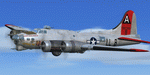
This folder contains a repaint for the A2A WoP2 B-17G in the colors of B-17G 42-97061 LL-B General Ike" of the 401st BS/ 91st BG based in Bassingbourne UK. One of the more well known B-17's of the 91st BG, was originally assigned to the 457th BG, but came to the 91st after only 3 days there, on the 16th March 1944. The aircraft was christened by Genral Eisenhower himself, when he visited the 91st BG on 11 April 1944. The noseart was painted by Cpl. Tony Starcer, with the lettering being done by Cpl. Elvis White. Both artists signed their work, though Cpl White's name later disappeared from the aircraft. Eisenhower liked the painting, but remarked to Cpl Starcer that his eyes were not blue-grey at all. "General Ike" survived the war and returned to Kingman Az, where she was scrapped. On its 65th mission, prop 3 started windmilling and sheared off, hitting the fuselage just below the co-pilots feet, but the only damaged was to the noseart, which was quickly repainted by Cpl Starcer. "General Ike" flew many missions as lead ship, because, as Capt John Davis said after returning from its 21st mission: "She's a mighty sweet plane, not too hot or fast, she moves steadily along. You don't want a fast aircraft for group lead."Ike" gets you over the target and brings you back again", which she did, again and again until the end of the war.
Repaint by Jan Kees Blom, based on the paintkit by A2A.
| Filename: | Boeing_B17G_91st_BG_LLB_General_Ike.zip |
| License: | Freeware |
| Added: | 7th October 2019, 18:19:56 |
| Downloads: | 85 |
| Author: | Jan Kees Blom |
| Size: | 18.8 MB |
| Category: Flight Simulator 2004 - Scenery | |
| Thompson CYTH in northern Manitoba, Canada |
|
Images related to this file:
File Description:
Thompson is a city with around 13,000 inhabitants, located in northern Manitoba beside the Burntwood River. It serves as the administration centre for a large area of Manitoba and has industrial activities centred around mining and the processing of mined products. The version of the airport upon which this modification is based is the original posting in 2004 by CanUK Scenery. I would have made new buildings and a totally new scenery but I have the same problem as Sid and Pete in their later Thompson scenery: almost no photos!?! The update modifies the short end of the mainly gravel runway to asphalt (it was upgraded because it is regularly used as a taxiway) and also adds a later (2010?) gravel taxiway. The other ground modifications add allocated parking spots for fire fighting CL415 planes that are in the new AI, plus a lot more ga parking. You should already have some AI that includes Calm Air to see CYTH as it really is, the HQ of Calm Air. There are other additions including car parks and the usual sundry bits and pieces that inhabit every airfield. The CL415's with Manitoba textures are adaptations of what were originally Ontario planes and included with my post of Geraldton, not the most recent post in 2013, the one in 2007. If you don't have the planes get them from my Geraldton post. The AI version was made from the original piloted version which was by Massimo Taccoli. The AI helicopter was included in my post of Alma CYTF.
| Filename: | Thompson_CYTH_in_northern_Manitoba_Canada.zip |
| License: | Freeware, limited distribution |
| Added: | 23rd September 2018, 15:24:22 |
| Downloads: | 225 |
| Author: | Roger Wensley |
| Size: | 6.4 MB |
| Category: Flight Simulator X - Aircraft Repaints, Textures and Modifications | |
| De Havilland Canada DHC-6 Twin Otter CIRPAS #236 |
|
Images related to this file:
File Description:

This folder contains a repaint for the Aerosoft Twin Otter Extended, in the colors of 762256 (c/n 496). Formerly N83NX, this aircraft is registered with the US Navy, but flying for the Center for Interdiciplinary Remotely-Piloted Aircraft Studies (CIRPAS), a research center at the Naval Postgraduate School in Monterey, California. The CIRPAS Twin Otter is an instrumented twin-engine turboprop aircraft. It supports individual scientists as well as teams of scientists from various Universities and Laboratories who are interested in lower-tropospheric phenomena and air/sea interaction. Payload may be selected from a large suite of state of the art meteorological, aerosol, and cloud particle sensors, while additional equipment collaborating scientists may wish to include can be integrated as well. Twin Otter mission have been sponsored by ONR, NSF, DOE, NOAA, NASA, CARB, and NRL.
Instruments may be installed in racks inside the cabin where a well characterized community inlet delivers ambient air samples, or in pods either suspended by wing-mounted pylons or mounted on a hard point on the cabin roof. Optical ports and windows are on the airplane’s belly and in the cabin roof.
CIRPAS staff calibrates and maintains the facility payload and provides fully reduced, synchronized, and coherent data sets to the collaborating scientists.
The Twin Otter is based at the CIRPAS Marina Facility, but has been deployed to various locations in North, South, and Central America and Asia. Repaint by Jan Kees Blom, based on the paintkit by Aerosoft.
| Filename: | De_Havilland_Canada_DHC6_Twin_Otter_CIRPAS_236.zip |
| License: | Freeware |
| Added: | 14th July 2018, 16:51:20 |
| Downloads: | 218 |
| Author: | Jan Kees Blom |
| Size: | 16.23 MB |


© 2001-2026 AVSIM Online
All Rights Reserved
Privacy Policy |