
Where Flight Simulation Enthusiasts Gather from Around the World!
AVSIM Library - Search Results

| Category: Flight Simulator 2004 - AI Aircraft | |
| Chance-Vought F-8 Crusader (Part 2) |

|
Images related to this file:
File Description:

Chance-Vought F-8 Crusader (Part 2). I present a comprehensive AI traffic model package for this classic aircraft of modern military history.
This is an original 8-LOD model, with many animations and features thanks to a growing confidence in XML-coding and making FSDS work for me instead of the other way around.
Nicknamed "The Last Gunfighter", this aircraft was the last production aircraft for the US Navy and Marine Corps which used guns as primary armament, and was in service at the twilight of this age, as well as the dawn of the missile age. Like all combat-experience aircraft, it had a relatively short life during its operational use (only about twenty years or so as a fighter), but was used a little longer as a recce aircraft; and beyond that in export service to France and the Philippines. The Crusader was used extensively in combat operations in Vietnam, played a crucial role in the Cuban Missile Crisis, and gave the newer F-4 Phantoms a fair run for their money in terms of air combat capability during this time. It is interesting to note that the 'elderly' F-8 Crusader had a better kill overall ratio in air combat in Vietnam than its F-4 successor.
This is part two of this model series, covering the F-8D, F-8E, and F-8H base models; with a total of 22 model options and 54 individual squadron paints. I am fairly confident that if any operational squadron of the USN and USMC used this aircraft from the late 50s to the late 60s, it is covered here at some time frame. Subsequent releases will include the later USN/USMC models, as well as the French and Philippine exports. Extensive credits and instructions are in the documentation. Base model and paint by Michael Pearson, flight dynamics by Michael McIntyre.
| Filename: | ChanceVought_F8_Crusader_Part_2.zip |
| License: | Freeware |
| Added: | 6th January 2013, 12:10:52 |
| Downloads: | 872 |
| Author: | Michael Pearson |
| Size: | 19.65 MB |
| Category: Flight Simulator X - Scenery | |
| RAF Polebrook |
|
File Description:
On June 28, 1942, RAF Polebrook was officially turned over to the USAAF and the airbase became the base of the 97th Bombardment Group, the first USAAF heavy bomber organization to arrive in the UK. It was designated USAAF Station 110.
The 97th BG was assigned to the 1st Combat Wing, at RAF Bassingbourn. It's operational squadrons were divided between Polebrook and RAF Grafton Underwood:
340th Bomb Squadron (RAF Polebrook)
341st Bomb Squadron (RAF Polebrook)
The 97th BG conducted a total of 14 missions from Polebrook, attacking airfields, marshalling yards, industries, naval installations, and other targets in France and the Low Countries.
The group sortied 247 aircraft, dropped 395 tons of bombs on Nazi-controlled territory, and lost 14 aircraft. On October 21, 1942, the 97th Bomb Group was transferred to the Twelfth Air Force in the Mediterranean theater and Polebrook was unoccupied until April 1943.
351st Bombardment Group (Heavy)
On April 15, 1943, the 351st Bomb Group arrived at RAF Polebrook. It was assigned to the 94th Combat Wing, also at Polebrook. The group tail code was a "Triangle J". It's operational squadrons were:
508th Bomb Squadron (YB)
509th Bomb Squadron (RQ)
510th Bomb Squadron (TU)
511th Bomb Squadron (DS)
Boeing B-17G-85-BO Flying Fortress, Serial 43-38465 of the 510th Bomb Squadron. This aircraft survived the war and returned to USA on 8 June 1945
Douglas-Long Beach B-17G-30-DL Flying Fortress Serial 43-38116 of the 509th Bomb Squadron.The 351st's first completed combat mission took place on May 14, 1943, when 18 B-17's targeted a German Luftwaffe airfield at Kortrijk, Belgium. As the war progressed, the 351st operated primarily against strategic objectives in Germany, striking such targets as ball-bearing plants at Schweinfurt, communications at Mayen, marshalling yards at Koblenz, a locomotive and tank factory at Hannover, industries at Berlin, bridges at Cologne, an armaments factory at Mannheim, and oil refineries at Hamburg.This is for FSX and you will need to have Ted Andrews's RAF Hangars Library and his other great RAF Buildings. They can
be found on AVSIM. Search the FSX section for "Ted Andrews" - you'll find loads of his scenery object files for
RAF airfields. Follow his instructions on how to install them.
| Filename: | RAF_Polebrook.zip |
| License: | Freeware |
| Added: | 21st January 2009, 13:27:45 |
| Downloads: | 1,058 |
| Author: | Scott Berge |
| Size: | 15.01 KB |
| Category: Flight Simulator 2004 - Miscellaneous Files | |
| Flight dynamics Douglas DC-3 V7.0 |
|
File Description:
This Corrected Aircraft.cfg VERSION.7 dated OCTOBER 13th, 2003 Features the Following....
1. The DC-3 will now not level itself out on a coordinated turn
(This was the biggest issue and is now fixed)
2. Flaps now have a little more drag when used.
(Will realistically slow down for landings and you
wont roll down the runway so much)
3. Differential braking now has a little more power.
(Will realistically allow for tighter turns during taxi)
4. The DC-3 itself now has a little more power.
(Default version is underpowered and used up too much runway,
and.. Default version cruise speed was a little low).
5. Corrected Manifold pressure from 47" to 48" full power
(Default version had it slightly wrong)
6.Fuel is now down to 200 per tank
(Default has version was a little over)
7. All control surfaces, ailerons, rudder and elevators now have delay
(There is a certain lag time when flying a DC-3 and it now shows
with these corrections which delays your input to the controls)
8. Elevator trim is now fixed
(To much play in the default elevator trim , it is now fixed with
less play and also has a delay/lag effect)
9. Rudder trim now with delay/lag
10. Aileron trim now with delay/lag
11. Fuel Flow is now fixed, the DC-3 will burn 90 GPH instead of the original 118 GPH
12. Increased power scalar very slightly for correct cruise airspeed
13. Manifold pressure will decrease 1" MAP per 1,000 feet after 2,000 feet Altitude
13.Exactly 140 kias on full tanks at 9,000' ASL
14. Added Strobe Lights to the wings
15. Adjusted steering (just a tad) for better taxiing
16.Prop (rpm) and Power (map) throttles interact correctly
Took off some delay with ailerons and rudder
Removed some drag and pitch up from the flaps
Added more brake power to the differentials
17. Added a working NAV light to the Nose
I have also added a corrected DC-3 reference sheet". In the zip there are two aircraft.cfg's.. one is modified if you are already using the add-on for special effects.
| Filename: | Flight_dynamics_Douglas_DC3__V70.zip |
| License: | Freeware |
| Added: | 13th October 2003, 19:43:08 |
| Downloads: | 4,569 |
| Author: | Trev Morson |
| Size: | 16.58 KB |
| Category: Flight Simulator X - Original Aircraft | |
| B-52J |
|
Images related to this file:
File Description:
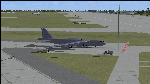
Since it became operational in 1955, the B-52 has been the main long-range heavy bomber of the U.S. Air Force. It first flew on Apr. 15, 1952. Nearly 750 B-52s were built when production ended in Oct. 1963. This "J" model is the future re-engined "h" model 60-0042 of the 917th Wing AFRC based at Barksdale AFB (KBAD). She flies higher, further, and faster than any previous version. The aircraft can cruise at 380 KIAS at 500 ft agl over about 5,000 nm which makes her capable of reaching targets within enemy airspace anywhere on the globe without being detected by radar until it's too late. Her normal high altitude cruise speed has been increased to Mach .88 above FL550E over 9,000 nm without refueling, and her service ceiling has increased to FL570E. The 50,000 lb payload is still nominal, but due to the lighter engines she now has more accomidations for the crew, and does not require refueling very often. She can range much further with less speed (i.e., Mach .85), but there is normally no need for that. This aircraft is designed to fly like the real thing. It is likely one of the best B-52 models available at this time. I have test-flown this aircraft around the globe several times to reassure myself that all is well. You will not have a bouncing effect occur when cruising with 16x speed acceleration and autopilot engaged because all aerodynamics and balance are perfected to a very low margin of error, or no error margin at all. Please be sure to read the INSTRUCT.TXT file for extended details. Original aircraft designer: Mike Stone; Textures by Bill Baldwin; Panel and gauges by Philippe Wallaert; Auto Smoke Effects by Richard Wisman; BR-725 Sound by Ronald Buffalo; Real World aero/engine dynamics, data, lights and effects by: Douglas E. Trapp, FS Flight Dynamics Engineer, Irving, Texas, [email protected], October 2018. The use of this model, and the configuaration of such, is designed for free educational purposes, and protected by the Free Use Act: (https://www.law.cornell.edu/uscode/text/17/107). This model and/or aspects of such cannot be used for monetary purposes!
| Filename: | B52J.zip |
| License: | Freeware |
| Added: | 27th October 2018, 18:57:21 |
| Downloads: | 628 |
| Author: | Douglas E. Trapp |
| Size: | 24.51 MB |
| Category: Prepar3D V1-4 - Aircraft Repaints, Textures and Modifications | |
| Douglas A-20C Boston Dutch Naval Air Service |
|
File Description:
This folder contains a repaint for the Douglas A-20C by Milton Shupe and his team. It shows Douglas DB7 Boston D52 of the Royal Dutch East Indies Navy, Andir, 6 March 1942. In december 1941, the Dutch government ordered 32 Douglas Boostons for the defence of the Dutch Indies after the outbreak of war in the Pacific. These aircraft were destined for the MLD, or Dutch Naval Air Service. The aircraft were painted in RAF camouflage colors and received Dutch orange triangles on the fuselage and the underside of the wings, together with a serial consisting of a D with a number and the text KON.MARINE on the nose. The aircraft were crated and shipped to the Dutch East Indies, with the first six arriving in Java on the 27th of February 1942, just a day before the Japanese landings in Java. The crates were unloaded in Tjilatjap. It was decided to try and assemble a few aircraft on the spot, in the harbor of Tjilatjap, while three crates were sent to Andir by train. Despite Japanese bombing raids on the harbor, the MLD technicians managed to assemble two Bostons in the harbor, and on the morning of the 5th of March, Lt Burgerhout, a Catalina pilot, took of from an improvised runway withh D52 and flew to Tasikmalaja, where it was planned to fill the aircraft with fuel for the flight to Andir air base. However, no suitable fuel was found. Before the second Boston could be flown out, the 'runway' was destroyed by a second Japanese bomb raid, so the ground crew destroyed the aircraft. The aircraft at Tasikmalaja was destroyed on the 8th of Mmarch, just before the capitulation of the Dutch East Indies. Of the aircraft transported by train, one was assembled, and this fell intact into the hands of the Japanese, who later used it for flight evaluations. The other two aircraft were destroyed by their ground crews. The other 26 Bostons still underway were diverted to Australia, and these later flew with no 22 squadron of the RAAF. Repaint by Jan Kees Blom, based on the paintkit by William Ellis.
| Filename: | Douglas_A20C_Boston_Dutch_Naval_Air_Service.zip |
| License: | Freeware |
| Added: | 16th July 2018, 16:43:50 |
| Downloads: | 109 |
| Author: | Jan Kees Blom |
| Size: | 8.32 MB |
| Category: Flight Simulator X - Scenery | |
| "Your Own Sea Port"..Part II of "Your Own" |
|
File Description:
This scenery is Part II of "Your Own" Series. The first one is "Your own AirPort"....
slowly but surely a community is being born!!!!!!...what do you get with YOSP??
--
"YO Airport" has contracted the " Marching Band and Construction Ltd" to construct the " YO-Seaport" near the rich Oil Fields of the coast. MBC Ltd, has thus proceeded full blast on this major important Sea Port which will give traffic to YO Airport and sorroundings.....Now planes will fly on rigid schedules between these two airfields......
later YO-Hill Airfields(Part III) will come along in the mountains in small lakes and Sea Stops...or small seaplane destinations....for more Fun and activities!!!!
What does "Your Own Sea Port" has for you.....?and what can you do there??
1) Two Airfields, one grass for small private planes and one Concrete for Commercial traffic ( new technique so it won´t be "sunk" with whatever mesh you have!!!) ...........+ Floatplane Base!!!
2) Helicopter Pad at the Port Hospital...(lighted)
3) Rescue Sailors at burning ship!!!!---(ship sinking fast!!)...take them to the Port´s Hospital.
4) Check moving traffic with any chopper.( There is a red corvette which must be checked with some women driving too fast!!!)
5) Participate in:
Road Race ( Need a car!!)...Prices galore!!!
Boat Race around Red Bull Pylons (need a Boat!!)...RedBull guys left them here for good!!!
Fly a Race at the same Pylons...(Really Hard!!!!)
6) Fly Tourists to Fishing Lake where Bass Abounds..(Need Floatplane).
8) Fly with your Navy Patrol plane and check on some "Strange Submarine
taking pictures of the port"...if necessary blow it to smitherins!!!!!!!
9) Open a New Airline....YO Air Service Inc...
10) Fly around and take pictures.
11) Take executives to the Oil Facilities in the Interior (EpisodeIII)...
or just fly around with your gal, wife or hummmm, hummmm.............or go fly under its three bridges!!!!!
12) Take passenger from the "Float Plane" Airpark, near the hospital, to lakes and rivers. The Mayor of YOSP will be giving the "city Keys" to all Pilots
who makes four consecutive loops in a helicopter on Sunday at 11:42:45.
| Filename: | Your_Own_Sea_PortPart_II_of_Your_Own.zip |
| License: | Freeware, limited distribution |
| Added: | 28th November 2008, 15:48:14 |
| Downloads: | 1,513 |
| Author: | Gera Godoy Canova |
| Size: | 900.13 KB |
| Category: X-Plane - Original Aircraft | |
| B25 Mitchell Bomber |
|
File Description:
B25 Mitchell for X-Plane 6.40-6.6 Made famous by the Doolittle raid on Tokyo shortly after Pearl Harbour the B25 Mitchell bomber is the most famous medium bomber of WWII and perhaps of all time. The B25 was the most numerous twin engine aircraft built by the US during WWII; estimates of production vary from 9300 to 11000 built. On April 18, 1942 Doolittle led sixteen B-25 aircraft from the navy carrier, U.S.S. Hornet to bomb Japan in retaliation for that country's attack on Pearl Harbor on December 7, 1941. Although little damage was done and all planes were lost the raid proved to be one of the most famous missions of the war. The B25 was powered by a pair of 1,700 hp Wright R-2600-29 "Cyclone" 14 cylinder, air-cooled engines. Maximum speed was 272 mph at 15,000 ft, with a ceiling of 24,000 ft and a range of 1350 miles with a full load of bombs. Armament varied considerably in the B25 depending on the type of mission the plane was designed for. Heavenly Body is a B25J designed as a bomber, so it carried eleven 0.50 caliber machine guns; two in the top turret, two in the tail, one in the nose, two in cheek packs on each side under the pilot and one in each waste window. The top, nose and cheek pack guns could also be used in strafing, if so desired. This version carried 3,000 lbs of bombs (usually six 500 pounders) in an interior bomb bay. The X-Plane version is a fairly faithful rendition of the B25. The body consists of two sections consisting of the fuselage and a fuel tank. The main engine nacelles actually consist of two nacelles, one is the 1700 HP engine, the rear section is a 5 lb thrust rocket. Engine nacelles are also used for the two rudders in order to get the correct shape. Vertical stabilizers with rudders are buried within the nacelles. Decoration of the plane is complicated by the use of multiple nacelles but the resulting compromise is acceptable though not an authentic replica.
| Filename: | B25_Mitchell_Bomber.zip |
| License: | Freeware, limited distribution |
| Added: | 27th March 2003, 01:20:45 |
| Downloads: | 1,669 |
| Author: | Robert App |
| Size: | 1.37 MB |
| Category: X-Plane - Original Aircraft | |
| B25 Mitchell v1.1 for x-plane 6.4/6.51 |
|
File Description:
B25 Mitchell v1.1 for X-Plane 6.4/6.51 upgrade from v1.0 includes better handling and improved non-custom panel. Made famous by the Doolittle raid on Tokyo shortly after Pearl Harbour the B25 Mitchell bomber is perhaps the most famous medium bomber of WWII and perhaps of all time. The B25 was the most numerous twin engine aircraft built by the US during WWII estimates of production vary from 9300 to 11000 built. On April 18, 1942 Doolittle led sixteen B-25 aircraft from the navy carrier, U.S.S. Hornet to bomb Japan in retaliation for that country's attack on Pearl Harbor on December 7, 1941. Although little damage was done and all planes were lost the raid proved to be one of the most famous missions of the war.
The B25 was powered by a pair of 1,700 hp Wright R-2600-29 "Cyclone" 14 cylinder, air-cooled engines. Maximum speed was 272 mph at 15,000 ft, with a ceiling of 24,000 ft and a range of 1350 miles with a full load of bombs. Armament varied considerably in the B25 depending on the type of mission the plane was designed for. Heavenly Body is a B25J designed as a bomber, so it carried eleven 0.50 caliber machine guns; two in the top turret, two in the tail, one in the nose, two in cheek packs on each side under the pilot and one in each waste window. The top, nose and cheek pack guns could also be used in strafing, if so desired. This version carried 3,000 lbs of bombs (usually six 500 pounders) in an interior bomb bay.
The X-Plane version is a fairly faithful rendition of the B25. The body consists of two sections consisting of the fuselage and a fuel tank. The main engine nacelles actually consist of two nacelles, one is the 1700 HP engine, the rear section is a 5 lb thrust rocket. Engine nacelles are also used for the two rudders in order to get the correct shape. Vertical stabilizers with rudders are buried within the nacelles. Decoration of the plane is complicated by the use of multiple engine nacelles but the resulting compromise is acceptable though not an authentic replica.
| Filename: | B25_Mitchell_v11_for_xplane_64651.zip |
| License: | Freeware |
| Added: | 2nd March 2003, 00:05:15 |
| Downloads: | 310 |
| Author: | Robert App |
| Size: | 1.41 MB |
| Category: X-Plane - Original Aircraft | |
| B25 Mitchell for X-Plane 6.40/6.51 |
|
File Description:
B25 Mitchell for X-Plane 6.40/6.51. Made famous by the Doolittle raid on Tokyo shortly after Pearl Harbour the B25 Mitchell bomber is the most famous medium bomber of WWII and perhaps of all time. The B25 was the most numerous twin engine aircraft built by the US during WWII; estimates of production vary from 9300 to 11000 built. On April 18, 1942 Doolittle led sixteen B-25 aircraft from the navy carrier, U.S.S. Hornet to bomb Japan in retaliation for that country's attack on Pearl Harbor on December 7, 1941. Although little damage was done and all planes were lost the raid proved to be one of the most famous missions of the war.
The B25 was powered by a pair of 1,700 hp Wright R-2600-29 "Cyclone" 14 cylinder, air-cooled engines. Maximum speed was 272 mph at 15,000 ft, with a ceiling of 24,000 ft and a range of 1350 miles with a full load of bombs. Armament varied considerably in the B25 depending on the type of mission the plane was designed for. Heavenly Body is a B25J designed as a bomber, so it carried eleven 0.50 caliber machine guns; two in the top turret, two in the tail, one in the nose, two in cheek packs on each side under the pilot and one in each waste window. The top, nose and cheek pack guns could also be used in strafing, if so desired. This version carried 3,000 lbs of bombs (usually six 500 pounders) in an interior bomb bay.
The X-Plane version is a fairly faithful rendition of the B25. The body consists of two sections consisting of the fuselage and a fuel tank. The main engine nacelles actually consist of two nacelles, one is the 1700 HP engine, the rear section is a 5 lb thrust rocket. Engine nacelles are also used for the two rudders in order to get the correct shape. Vertical stabilizers with rudders are buried within the nacelles. Decoration of the plane is complicated by the use of multiple nacelles but the resulting compromise is acceptable though not an authentic replica. As usual my panel leaves a lot to be desired but version 2 will correct this.
| Filename: | B25_Mitchell_for_XPlane_640651.zip |
| License: | Freeware, limited distribution |
| Added: | 25th February 2003, 00:15:23 |
| Downloads: | 495 |
| Author: | Robert App |
| Size: | 1.85 MB |
| Category: Flight Simulator 2004 - Scenery | |
| PABR - Barrow - Alaska, USA |
|
Images related to this file:
File Description:
The town of Barrow is in the far north of Alaska, and is best known in flying circles as the place where Wiley Post crashed his floatplane on takeoff and killed himself and Will Rogers. The crash was some 15 miles south of Barrow and was "assisted" by the mismatched fuselage, wings, and floats that had been assembled to create the floatplane. The Barrow population is largely Inupiat and totals some 4,400. The downtown area of Barrow is immediately north of the airport. The second and largest part of Barrow is further north past a string of lagoons and is locally called Browerville. To the northeast along the coast is the smallest part around what used to be the Naval Arctic Research Lab, and is now a college. To the east of this are the DEW buildings, plus two large navy hangars and the gravel runway that was used to serve the DEW station. The PABR runway is aligned 06-24 in FS9 and is 7,100 feet long and 150 feet wide, built on top of a gravel base and surround that copes with the underlying permafrost. There is PAPI at both ends and an ILS and approach lights on 06; 06 circuits are to the right. The airport notes include a warning that the apron is not a standard width and that large planes that are enroute to the far end of the runway will not be able to taxi past a plane parked at the gate and should use the runway as a taxiway, then turn and takeoff. FS9 AI cannot cope with that, so the apron here is wider. There are, in real life and the AI, daily flights by Air Alaska (three at least) and Era (several, and which is now called Ravn, hence the new hangar door motif) and air cargo flights by Northern Air Cargo and Everts, plus GA. The buildings have been made with photographic textures or textures made from reference photos. I decided that while 500+ scenery objects was probably ok for most people the required 900+ to "make" the town of Barrow would likely not be. The auto-generated FS9 town objects could not be left as Barrow with trees would not look at all like reality; I have "faded" the density of the town buildings into the distance from the airport.
| Filename: | PABR__Barrow__Alaska_USA.zip |
| License: | Freeware, limited distribution |
| Added: | 17th May 2016, 09:32:36 |
| Downloads: | 971 |
| Author: | Roger Wensley |
| Size: | 15.12 MB |


© 2001-2026 AVSIM Online
All Rights Reserved
Privacy Policy |