
Where Flight Simulation Enthusiasts Gather from Around the World!
AVSIM Library - Search Results

| Category: Flight Simulator X - Original Aircraft | |
| JELAIR - Maersk Air, Boeing 737-2L9 (OY-MBZ) - version 3 |

|
Images related to this file:
File Description:
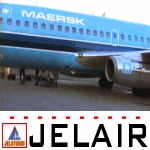
This aircraft (for FSX, with update-patch #2) is a simulated replica of Maersk Air's 'Pocket Rocket' OY-MBZ (a Boeing 737-2L9 a.k.a. 737-200/Advanced) anno 1989. It is designed for a screen-resolution of 1280x1024. Other resolutions have not been tested. It will NOT work correctly in FS2004 (FS9). It has been tested on Windows XP (32bit) and Windows 7 (64bit) only. It is designed to be as realistic as possible, and flight-experience from the real aircraft, as well as large amounts of documentation, have been used to get it as accurate as possible. It has a fairly advanced panel with many systems simulated, such as a passenger oxygen system, a cabin pressure system, anti-skid brakes, EPR control of each engine (with the possibility of asymmetric thrust), IVSI with TCAS, Sperry SP177 autopilot with working CWS and level-change button, active yaw-damper, Quality-of-flight index (so you can see how well you operate the aircraft), windshield wiper, custom flight-computer, automatic Vspeeds for takeoff and landing, takeoff trim calculator, master caution system, PAX simulator (if you make a mistake they may die), a JT8D-17 engine with slow spin-up time (do not idle it on approach). It features a relatively realistic random-failures/error simulation which will trigger, or de-trigger, any of a variety of possible failures/errors (from small gauge-errors to large engine-failures or cabin de-compression). The chance of a failure/error is very low (you may never even get one, but they can happen, so stay alert), maybe less than 1 percent chance per 24 hours of flight-time. It features engine-management simulation, so overheating an engine will cause it to fail (now you actually need to pay attention to the EGT during engine-startup, and have your finger ready at the fuel-cutoff switch just in case you need to save the engine from heat-damage). It features sounds recorded from the actual aircraft (OY-MBZ).
This is the third release of this JELAIR addon. A very big thank you to all the following very talented people that participated directly or in-directly in the production of this add-on: Original Model by Erick Cantu, Original Panel by Pablo Contouris, Original Panel BMP by Bob Scott, Original Panel Gauges by Ken Mitchell, Doug Dawson, Pierre Fasseaux, SPanel, www.FS2X.com, Original Sound by Christoffer Petersen, Original Textures by Henry William, FDE, various modifications and adjustments for aircraft type, as well as additional gauges and sounds by JELAIR
| Filename: | JELAIR__Maersk_Air_Boeing_7372L9_OYMBZ__version_3.zip |
| License: | Freeware |
| Added: | 16th April 2011, 13:52:24 |
| Downloads: | 7,035 |
| Author: | Erick Cantu, Pablo Contouris, Bob Scott, Ken Mitchell, Doug Dawson, Pierre Fasseaux, Christoffer Petersen, Henry William, Jacob Larsen |
| Size: | 80.51 MB |
| Category: Flight Simulator X - Aircraft Repaints, Textures and Modifications | |
| Delta Airlines Boeing 757-200 (N672DL) |
|
Images related to this file:
File Description:
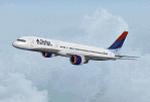
TDS (Tenkuu Developers Studio) Boeing 757-200 PW 2040 model, in the Delta Wavy Gravy livery, registration N672DL. Includes custom Cabin and Ground Support Equipment and personnel textures and both winglet textures for those that want to use winglets. Lots of mild weathering and other new details including photo real refuel station under right wing as well as the refueling access panel and new wing textures. New photoreal Landing and taxi light lenses on the nose gear and wings. A special thanks to Luis Castro for the winglet night lighting and the photoreal wing tops and flaps and Nick Chinn for the refueling station photos from a real Delta 757 that helped me enhance these textures even more....
Model developed by Tenkuu Developers Studio, features high resolution textures, dynamic flexing wings, nose gear steering, rudder lock, ground spoilers, low speed aileron locks at high speed, fully animated control surfaces, fully independent suspension, trim animation, opening passenger doors, rolling wheels, animated thrust reverse with reverser block doors, detailed textures, full night lighting, ground service vehicles and more. Model design by Hiroshi Igami. Flight dynamics design by Nate Rosenstrauch and Joe DeGregorio. Paint kit and master textures by Carlos Eduardo Salas. TDS members: Hiroshi Igami,Nick Wilkinson,Carlos Eduardo Salas,Yosuke Ube,Stian Svensen,David Biggar, Luiz Antonio Perina,Nate Rosenstrauch, Joe DeGregorio. By Joe DeGregorio. Enjoy!!
| Filename: | Delta_Airlines_Boeing_757200_N672DL.zip |
| License: | Freeware |
| Added: | 16th October 2018, 16:26:56 |
| Downloads: | 497 |
| Author: | Joe DeGregorio - TDS |
| Size: | 12.79 MB |
| Category: Flight Simulator X - Original Aircraft | |
| B-2A Spirit Stealth Bomber |
|
Images related to this file:
File Description:
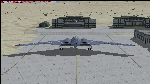
The B-2A Stealth Bomber is the most sophisticated aircraft on the planet. She is essentially a “Flying Wing†platform with no V-Tail, and is controlled by pre-programed flight computers stationed in various positions within the crew cabin and wings. There is one main computer that controls the aircraft, with two redundant back-up computers assigned to it in case of failure. All additional computers are assigned to functions involving flight control, system monitoring, data communications, and radar. Engine and Aerodynamic effects are controlled by these computers which serve several actuators and ailerons, including the spoilerons, which further compensate for the lack of a V-Tail. In theory, and because of these computers, the aircraft is “Stall-Proofâ€. The only way it can stall is if the computers fail. There is no way she can be flown without the computers active. The REAL aircraft does almost everything based on pre-programed data, other than taxi to the runway (although this is also possible to program). Before each flight, the Mission is designed and then assigned to the Mission Flight Box (Portable Computer) which is then carried by the Commander to the aircraft, and the data from the box is “transferred†to the main on-board computers. Because of this, the B-2 cannot be flown until the box is ready for the mission, and pilots cannot simply jump in and fly her, with the exception that the data is transferred via satellite. Everything is pre-planned, and this takes several hours. Once the data is on-board, the taxi can begin. When lined-up on the runway, all the pilot needs to do is push a button or three. Everything else is computer controlled until landing. The aircraft CAN be flown manually with basic data inputs into the main computer systems, but even in that case it is not conventional. If a pilot wants to turn right, he sets the data to turn to a certain degrees of heading. The same with climb and descent, speed increase or decrease. A pilot cannot over-ride the computers in any case, so steep banks, climbs, or descents cannot be forced. There is a lot of space for the two member crew within the cockpit, but there is also a space reserved for one observer. This additional seat is known as “Suicide Position†because there is no ejection seat for that observer. In the event of a mishap, the observer can try to bail-out through the ejection hatches after the pilots, or can try the exit ramp door, or the bomb bay as an exit route. The odds of escape for the observer are very small, but he has a parachute as reassurance. Otherwise, what the crew does during missions is only a guess, since they really don't have to do anything unless an alarm goes off. Since the plane flies so smooth, we can only imagine what sort of things they may dream-up to entertain themselves during a long flight. High altitude flights are conducted at night mainly due to the obvious contrail such a flight will exhibit during the day with such hot engines. The engines are encased in a heat absorbing shield material (still exhaust exists), and the rest of the plane is coated with Radar absorbant material, with the additional low profile effect of the aircraft design itself. If it can be seen by the ground or a fighter, it can be attacked by fighters or the ground. During daytime flight they will stay below the contrail level, and monitor the radar systems in preparations for counter-measures. If a fighter can visually observe them, the fighter may be able to shoot them down with bullets from behind, but not likely with missiles because of the sophisticated counter-measures available. On Radar the aircraft appears the size of a pigeon, until about 8 to 10 miles away, which would be too late to counter from the ground, so most attacks are either done at night or during the day at very low altitude. Upon landing the aircraft is automated down to about 200 feet AGL, when the pilot takes command. All she/he does at this point is allow her to glide down and contact the runway, and retard the engines. Brakes are used to slow, then the computers are turned off, and the pilot can control the throttles, nose gear, and brakes. The Commander watches for obstructions, mainly, and communicates with the tower and ground crew. Everything in this model has been reconfigured to meet realistic standards, without any tricks or flight tuning, and following real world aerodynamic principals and available data, including MOI. The panel requires study before use, but very realistic. The sounds are very authentic. There is no other model offered anywhere that compares to what you have now available in front of you. Please read and study the Readme.txt file within the main folder before attempting to fly this 2.2 Billion Dollar aircraft. Yes, that's correct ... $2,200,000,000 each! The use of this model, and the configuration of such, is designed for educational purposes, and protected by the Free Use Act: (https://www.law.cornell.edu/uscode/text/17/107). The Authors will not approve redistribution for monetary purposes. Original aircraft design by Alphasim; VC Adaptation, panels and gauges by Philippe Wallaert; Sound by Ruggero Osto; REAL WORLD Engine/Aerodynamics, data and effects by Douglas E. Trapp ([email protected]) June 2018
| Filename: | B2A_Spirit_Stealth_Bomber.zip |
| License: | Freeware |
| Added: | 2nd June 2018, 17:16:30 |
| Downloads: | 1,038 |
| Author: | Douglas E. Trapp |
| Size: | 14.81 MB |
| Category: Flight Simulator X - Aircraft Repaints, Textures and Modifications | |
| FS2004/FSX/P3D Project OpenSky V4 Japan Airlines JA8089 Boeing 747-446 |
|
Images related to this file:
File Description:

(TEXTURES ONLY)
(ONLY TESTED IN FSX: STEAM EDITION)
So I made a slight mistake in my last add-on (The Northwest Orient Cargo 747-200SF one) where I provided the resources required for advanced animations to be enabled in the POSKY 747 from Rikoooo, since in they default they did not include it. In there, I accidentally added the wrong "Contact Points" line that causes the 2 inner main landing gears to be slightly tilted when on the ground. I fixed it here. To apply the fix, just copy and paste the contact lines inside the aircraft.cfg file, that's it.
I originally supposed to be making 1 single livery for this exact aircraft, which is the 2002 Colors wearing the "Thank you for 41 Years" Sticker, but then went into a rabbit hole and found about the small Yokoso! Japan Sticker in the 2000s, the "BIG express" Decal in the 90s, and also the "Nippon Love Goal" Sticker. So I just had to do it.
I also improved the windows by using the windows from the CLS 747 Paint Kit, and re-arranged them.
Instructions and more information are included in the readme file.
| Filename: | FS2004FSXP3D_Project_OpenSky_V4_Japan_Airlines_JA8.zip |
| License: | Freeware |
| Added: | 19th March 2026, 14:09:48 |
| Downloads: | 65 |
| Author: | Ryubunao |
| Size: | 409.76 MB |
| Category: Flight Simulator X - Aircraft Repaints, Textures and Modifications | |
| FS2004/FSX Project Airbus Air Canada Rouge C-FYIY Airbus A319-114 (Liberal Party Of Canada Livery) |
|
File Description:
This was requested by Brent Warman on the Project Airbus Official Facebook Group. readme included
| Filename: | FS2004FSX_Project_Airbus_Air_Canada_Rouge_CFYIY_Ai.zip |
| License: | Freeware |
| Added: | 14th April 2025, 19:57:40 |
| Downloads: | 28 |
| Author: | Ryubunao1478 |
| Size: | 16.9 MB |
| Category: Flight Simulator X - Scenery | |
| 50 UL airfields which are not included in FSX, located in South-West of Germany, Part 4: |
|
File Description:
50 UL airfields which are not included in FSX, located in South-West of Germany:
Magolsheim, Muensingen-Eisberg, Hayingen, Huelben, Farrenberg, Dettingen, Oppingen-Au, Walxheim-Unterschneidheim, Schwaigern, Neuenstadt am Kocher, Moeckmuehl-Korb, Baumerlenbach, Ottmarsheim-Mundelsheiem, Oberrot-Glashofen, Mittelfischach, Weipertshofen, Hornberg Ostalb, Leuzendorf, Obersoellbach, Hermuthausen, Doerzbach-Hohebach, Gundelsheim, Hagensteiner Hof, Rastatt, Landau-Ebenberg, Bundenthal-Rumbach, Ohlsbach, Hilzingen, Boesingen, Muellheim (Baden), Reiselfingen, Antdorf, Paterzell, Ohlstadt-Poemetsried, Antersberg, Wasentegernbach, Altoetting, Etting, Altomuenster, Eschelbach, Strassham, Aichach, Burgheim, Irsingen-Hesselberg, Peiting, Fuessen, Berg /Ravensburg, Isny-Rotmoos, Kisslegg-Wangen, Riedlingen
| Filename: | 50_UL_airfields_which_are_not_included_in_FSX_loca.zip |
| License: | Freeware |
| Added: | 16th November 2017, 16:53:11 |
| Downloads: | 588 |
| Author: | Juergen Wolf |
| Size: | 32.85 MB |
| Category: Flight Simulator 2004 - AI Aircraft | |
| Phantom FG.1 - Royal Navy No. 892 Naval Air Squadron (1977 - Silver Jubilee of Elisabeth II markings) |
|
Images related to this file:
File Description:
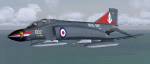
Phantom FG.1 textures for Royal Navy No. 892 Naval Air Squadron in 1977 (Silver Jubilee of Elisabeth II markings).
To be used with Fernando Martinez' F-4B and/or FGR.2 Phantom II AI models. (f4b_for_bige.zip available here, ai_fgr2.zip available at Flightsim.com)
| Filename: | Phantom_FG1__Royal_Navy_No_892_Naval_Air_Squadron_.zip |
| License: | Freeware |
| Added: | 13th December 2009, 20:01:04 |
| Downloads: | 250 |
| Author: | Hartwig Ullrich |
| Size: | 5.32 MB |
| Category: Flight Simulator 2004 - Aircraft Repaints, Textures and Modifications | |
| USAF F-111F Aardvark, 524th TFS "Hounds of Heaven", 27th TFW, Canon AFB, New Mexico, circa 1995 |
|
File Description:
USAF F-111F Aardvark, 524th TFS "Hounds of Heaven", 27th TFW, Canon AFB, New Mexico, circa 1995; utilizing Mike Stone's F-111 series models, available at Mike's website (www.pmstone.com). This mainstay of USAF tactical strike capability saw thirty years of distinguished service from Vietnam to the 1991 Gulf War; being retired in the mid-1990s. This aircraft is great for AI as well. Aircraft models and base textures by Mike Stone.
| Filename: | USAF_F111F_Aardvark_524th_TFS_Hounds_of_Heaven_27t.zip |
| License: | Freeware |
| Added: | 1st September 2005, 01:31:40 |
| Downloads: | 473 |
| Author: | Michael Pearson |
| Size: | 635.17 KB |
| Category: Flight Simulator X - Aircraft Repaints, Textures and Modifications | |
| F/A-18C Hornet No.401 of VFA-204 'River Rattlers', Navy Reserve Aircraft, early 1950's |
|
Images related to this file:
File Description:
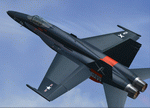
F/A-18C No.401, BuNo 162866, VFA-204 "River Rattlers", NAS New Orleans.
Painted as Navy Reserve Aircraft (Gloss Sea Blue), early 1950's.
| Filename: | FA18C_Hornet_No401_of_VFA204_River_Rattlers_Navy_R.zip |
| License: | Freeware |
| Added: | 22nd February 2011, 12:46:40 |
| Downloads: | 260 |
| Author: | Serge Luzin |
| Size: | 1.32 MB |
| Category: Flight Simulator X - Scenery | |
| RAF Elvington |
|
File Description:
The station was originally a grass airfield within No. 4 Group. In the early 1940s the airfield was entirely reconstructed with three hardened runways replacing the grass. It re-opened in October 1942 as a station for 77 Squadron RAF and along with RAF Melbourne and RAF Pocklington was known as No "42 Base". The squadron had a strength of approximately 20 aircraft and initially used the twin engined Armstrong Whitworth Whitley medium bomber although this was quickly replaced by the Handley Page Halifax four engined heavy bomber which was being introduced. No 77 Squadron suffered heavy losses during its time at Elvington with over 500 aircrew killed, missing or taken prisoner and almost 80 Halifaxes lost as it played a major part in the Battle of the Ruhr and the bombing of Berlin.
In May 1944 No 77 Squadron posted to the newly opened nearby RAF Full Sutton and was replaced at Elvington by two French squadrons, numbers 346 "Guyenne" and 347 "Tunisie" who both played a leading part in the bombing of Germany. Elvington was the only airfield in the United Kingdom used by the remainder of the Free French Forces, they also flew Handley Page Halifax heavy bombers until they moved to Bordeaux in October 1945 where they became the basis for the new air force of liberated France. In September 1957 a memorial was unveiled in Elvington village dedicated to the two French squadrons. While they were at RAF Elvington nearly half of the squadrons' members were killed.
After the war the 400-acre (1.6 km2) airfield was transferred to No 40 Group under the control of Maintenance Command until 1952 when it was greatly enlarged and extended for use by the United States Air Force.
United States Air Force use
The United States Air Force (USAF) built a new 3,094 m (10,151 ft) runway, which was the longest in the north of England, and a huge 19.8 hectares (49 acres) rectangular hardstanding apron as well as a new control tower to turn Elvington into a "Basic Operation Platform" which would have operated as a Strategic Air Command (SAC) dispersal airfield. After spending £4 million the airfield never became operational as a SAC base and was abandoned by the US Air Force in 1958.
Other uses
In the early 1960s the Blackburn Aircraft Company, now part of British Aerospace used the runway for test flights of the Blackburn Buccaneer. Elvington retained its status as an RAF relief landing ground and was used by the RAF flying training schools at RAF Church Fenton and RAF Linton-on-Ouse until the airfield was finally closed in March 1992.
Present day
The airfield is now owned by Elvington Park Ltd. The adjacent buildings and control tower have been restored, and serve as the Yorkshire Air Museum which has many varied and rare aircraft and exhibits, including a complete Halifax bomber. Elvington is also a popular motorsports venue for motorcycle racing.
Source:Wikipedia
| Filename: | RAF_Elvington.zip |
| License: | Freeware |
| Added: | 10th April 2017, 22:08:13 |
| Downloads: | 167 |
| Author: | Terry Boissel |
| Size: | 220.79 KB |


© 2001-2026 AVSIM Online
All Rights Reserved
Privacy Policy |