
Where Flight Simulation Enthusiasts Gather from Around the World!
AVSIM Library - Search Results

| Category: X-Plane - Original Aircraft | |
| Boeing B314 Clipper for X-Plane 6.40/6.51 |

|
File Description:
Boeing B314 Clipper v1.0 for X-Plane 6.4/6.51- Built for Pan American Airways to expand their Clipper fleet, they also saw service for the US Navy and BOAC. The "clipper" name was appropriate because the Sikorsky S42, the Martin M130 (also available for X-Plane on AVSIM) and the Boeing B314 opened up long distance air lanes in 1930's and 40's the same way that the clipper ships opened up sea trade in the late 1800's. The model flies very well and is as accurate as the limited plans available to me. Due to limitations in shaping airfoils the outside rudders are actually engine nacelles (jets with 5 lb of thrust) and the lower wing is also an engine nacelle. The rear section of the fuselage is actually a gas tank or float section used to get better detail in the fuselage. As all of my models the exterior paint and panel can use a lot of work. What you see here is approximately 6-8 hours of modelling/decorating? work plus 16-20 hours or more of test flights.
Number built: total 12, 6 A314's built with upgraded engines and increased range
Engines: 4 - 1,600 HP, Wright R-2600, Twin Cyclone ,14 cylinder, air-cooled, radial engines. Wing Span: 152 ft. Length: 106 ft Max GW: 84,000 lb. Max level speed: 193 mph Cruising speed: 183 mph Range: 3,500 (5,200 A314) miles First flight: June 7, 1938, last retirement 1951. Ceiling: cruise 13,400, maximum 19,600 feet
Accommodation: 10 crew, 74 (36 night) passengers.
| Filename: | Boeing_B314_Clipper_for_XPlane_640651.zip |
| License: | Freeware |
| Added: | 12th February 2003, 22:41:20 |
| Downloads: | 639 |
| Author: | Robert App |
| Size: | 1.06 MB |
| Category: Flight Simulator X - Original Aircraft | |
| Avia BH-5 & Avia Bk.11 |
|
File Description:
The plane was constructed according to the type BH-1, the first successful plane produced by the Avia Works. It was an all-wooden two-seat training, sports and messenger plane, which was bigger than BH-1, more solid and more sophisticated, in its aerodynamics and technology. It was designed for flying basic acrobatics. The BH-5 was the first Czechoslovak plane to win an international contest and thus received the King of Belgium‘s Prize and the prize of the Belgian Tourist Aircraft Contest in 1923. The pilot, Zdenìk Lhota, flew to Brussels and back with a layover in Mayence at an average speed of 138 km/h. In 1923 this was a remarkable performance, not only in the sport-plane category. In 1923, the type BH-5 also won the “D“ category in the President of the Republic’s Contest. The Walter NZ-60, a radial five-cylinder engine, was installed in the BH-5 plane; it was the very first and a very successful engine designed by the Walter Company. Based on the results of military tests of the BH-5s, the Ministry of Defense placed an order for a series of slightly improved BH-9, BH-10 and later also BH-11 Avias, which had been successful in many national, as well as international contests and also in record and promotion flights. The BH-5 Avia plane was marked L-BOSA; thanks to this mark, all the planes of this very successful series were nicknamed “boska“. This addon has detailed 3D model and VC, original sounds, real flight dynamics and manual.
| Filename: | Avia_BH5__Avia_Bk11.zip |
| License: | Freeware, limited distribution |
| Added: | 8th December 2007, 23:10:17 |
| Downloads: | 3,730 |
| Author: | Štìpán Obrovský, Czechoslovak Historic Flight www.hictoricflight.cz |
| Size: | 31.66 MB |
| Category: X-Plane - Original Aircraft | |
| Black Cat Catalina PBY5/5Av1.1 for x-plane |
|
File Description:
This update includes improvements to the fuselage shape, addition of retractable wing floats using wheel farings, an improved but not custom panel, improved prop efficiency and more. The PBY Catalina is probably the best known flying boat with over 4000 produced by Consolidated aircraft and licensees. The Black Cat squadrons all done in flat black played havoc particularly for the Japanese in the Pacific. Fitted with radar, with a 15 hour endurance and 2800 mile range they hunted Japanese naval ships by night and bombed or torpedoed them by the hundreds up. There are 6 engine nacelles used in the model, 2 represent the 1200 HP radial engines driving the props, the others are jets with 5 lbs of thrust, 1 is used for the rear fuselage section, 1 is used for the wing pylon, 1 is used for the flare from the fuselage to the vertical stabilizer and the last is used for the forward observation and gunner space. Two are not used. Wing sections are taken up by the main wing and the support spars so there you go. The fuel tanks are used for the side gunner pods since these can be decorated separately. The plane flies very well and is stable as a rock. Takeoffs from water are quite easy as long as you don't dip a wing tip (no floats remember). The Black Cat squadron logo used in the paint scheme is courtesy of http://www.daveswarbirds.com/blackcat/logos.htm and is from the VP-71 Black Cat squadron.
| Filename: | Black_Cat_Catalina_PBY55Av11_for_xplane.zip |
| License: | Freeware, limited distribution |
| Added: | 9th March 2003, 22:48:18 |
| Downloads: | 1,218 |
| Author: | Robert App |
| Size: | 136.75 KB |
| Category: Flight Simulator 2004 - Original Aircraft | |
| Dinfia I.A.35-II "Huanquero" |
|
Images related to this file:
File Description:
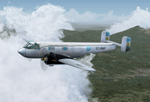
The IA-35 "El Justicialista del Aire" (renamed "Huanquero" in 1955) was the first design from the Dinfia Organisation of Argentina to enter production and the head of a family of succesful planes that later included the Ia-35 X "Pandora", the "Guarani I" and the turbopowered Ia-50 "Guarani".
A twin-engined all metal (except for fabric covered ailerons) low-wing cantilever monoplane with a high-mounted tailplane with two fins and rudders; and a retractable tricycle landing gear. Powered by two IA 19R "El Indio" radial engines of 750 HP each that allowed a maximum cruise speed of 370 km\h and a maximum range of 1250 KM with a full load of 2300 kg.
The major design was done by Paul Klages under the direct supervision of Prof. Kurt Tank, former Focke Wulf designer who also built the I.Ae 33 "Pulqui II" jet fighter in 1950.
The first series prototype of the Ia-35 made its maiden flight the 21st September of 1953 flown by First Lt. Pilot Connan Doyle, and was followed by a planned production batch of 100 aircraft but in the end less than half of the aircraft were built when production ceased in the mid-1960s.
Most of the Ia-35 Type II were assigned to the "II Brigada Aerea" of Parana to the "II Grupo de Exploracion y Ataque" where remained in service until 1974, when the lasts "Huanqueros" were replaced with the newest Ia-58 "Pucara".
Original 3D modeling (external and internal), flight dynamics, and "A-316" textures by Victor Astiz; sound set by Gary Jones; additional textures and general modding by Damian Radice.
| Filename: | Dinfia_IA35II_Huanquero.zip |
| License: | Freeware |
| Added: | 4th June 2010, 18:39:07 |
| Downloads: | 1,236 |
| Author: | Victor Astiz, Gary Jones, Damian Radice |
| Size: | 50.66 MB |
| Category: X-Plane - Original Aircraft | |
| Black Cat PBY5/5A |
|
File Description:
X-Plane 6.40
The PBY Catalina is probably the best known flying boat with over 4000 produced by Consolidated aircraft and licensees. The Black Cat squadrons all done in flat black played havoc particularly for the Japanese in the Pacific in WWII. Fitted with radar, with a 15 hour endurance and 2800 mile range they hunted Japanese naval ships and bombed or torpedoed them by the hundreds. This a fairly accurate rendition of the PBY except that the retractable pontoons are missing. Why? Well basically after using all the tricks I know I ran out of parts. There are 6 engine nacelles used in the model, 2 represent the 1200 HP radial engines driving the props, the others are jets with 5 lbs of thrust, 1 is used for the rear fuselage section, 1 is used for the wing pylon, 1 is used for the flare from the fuselage to the vertical stabilizer and the last is used for the forward observation and gunner space. Two are not used. Wing sections are taken up by the main wing and the support spars so there you go. The fuel tanks are used for the side gunner pods since these can be decorated separately. The plane flies very well and is stable. Takeoffs from water are quite easy as long as you don't dip a wing tip (no floats remember). This aircraft model and the paint scheme is copyright by Robert App, January 2003. Feel free to alter the paint scheme and instrument panel as long as you give me credit for the original design. The Black Cat squadron logo used in the paint scheme is courtesy of http://www.daveswarbirds.com/blackcat/logos.htm and is from the VP-71 Black Cat squadron. E mail me with any good panels or paint schemes and I will give full credit if used.
| Filename: | Black_Cat_PBY55A.zip |
| License: | Freeware, limited distribution |
| Added: | 16th January 2003, 02:56:49 |
| Downloads: | 1,386 |
| Author: | Robert L. App |
| Size: | 12.04 MB |
| Category: Flight Simulator 2004 - Original Aircraft | |
| Yakolev 52 |
|
Images related to this file:
File Description:

Re-upload following Avsim hack. Quoting from Wikipedia: "The Yakovlev Yak-52 is a Soviet primary trainer aircraft. It first flew in 1976 and is still being produced in Romania, by Aerostar, they gained manufacturing rights under agreement within COMECON socialist trade organisation now defunct. The Yak-52 was designed originally as an aerobatic trainer for students in the Soviet DOSAAF training organisation. That organisation trained both civilian sport pilots and military pilots.
Since the early 1990s and the fall of the Soviet Union, many Yak 52s have been exported to the west. Of the approximately 1,800 produced to date, most now fly in the United States, United Kingdom, New Zealand, Australia and other western countries.
A descendant of the single-seat competition aerobatic Yakovlev Yak-50, the all-metal Yak-52 is powered by a 360 hp, 9-cylinder radial engine, the Vedeneyev M14P. The aircraft has inverted fuel and oil systems permitting inverted flight for as long as two minutes. The engine drives a two-bladed counter-clockwise rotating, constant-speed, wood and fiberglass laminate propeller.
The tricycle landing gear is fully retractable, but it remains partially-exposed in the retracted position, affording both a useful level of drag in down manoeuvres and a measure of protection should the plane be forced to land "wheels up." Curiously the main wheels retract forward into the slipstream."
It has has been constructed using Gmax v1.2. The aircraft is constructed with as few polygons as possible and with a single texture file to ensure the absolute minimum impact on your framerates. The model has six LODs.
As usual, I have made three different textures for the aircraft. These are accurate textures which also includes the actual registration number of the aircraft as this seems to be what many desire to have.
It is designed specifically to enhance the AI aircraft population and to use with the marvellous GA-Traffic programme by Markus Brunner . It is also very flyable as a normal aircraft.
| Filename: | Yakolev_52.zip |
| License: | Freeware, limited distribution |
| Added: | 31st August 2010, 23:45:54 |
| Downloads: | 3,124 |
| Author: | Mike Cronin |
| Size: | 304.03 KB |
| Category: X-Plane - Original Aircraft | |
| Spruce Goose for X-Plane 6.4/6.51 (hk-1/H-4 Hercules) |
|
File Description:
Spruce Goose v1.0 for X-Plane copyright (c) by Robert App, January 2003. History of the "Goose" - Officially designated the HK-1 (this project started out as a join venture between Hughes Aircraft and Kaiser) and later designated the H-4 Hercules after Kaiser was unable to work with Howard. It was and still remains the largest (physical dimensions wingspan and length) aircraft ever built, with the largest radial engines ever built by the West (28 cylinder, 3000 HP). The plane had to be constructed mainly of wood due to the shortage of strategic metals caused by WWII. The plane became known as the "Spruce Goose" or "Flying Lumberyard" despite the fact that the wood frame and skin were constructed mainly of laminated poplar; it also involved "sandwich" construction. The plane was flown briefly on a trial taxiing run but Hughes never allowed the plane to be flown again. Speculation has always been rampant that the design was flawed and the plane could not have met the original specification requirements. The X-Plane model is as accurate as is possible with limited plans available to me. The main wing is an X-Plane standard symmetrical high lift airfoil as opposed to the high lift asymmetrical foil section used in the actual plane. The main wing angle of attack has been adjusted to emulate the asymmetrical foil as closely as possible.
Flight Testing the Goose - I have spent many hours testing the plane on X-Plane which with few exceptions provides a very accurate flight model. The published landing speed (79 mph) pretty well verifies the takeoff speed of 52 to 55 knots (k/hr x 1.15 (approx.) = mph). In straight flight the plane is difficult to stall since the nose quickly drops and increases speed if a stall develops with a significant loss of altitude. The plane has a range on 14000 gallons of fuel and takeoff weight of 350,000 Lbs of well over 3000 nautical miles. San Diego to Wake Island via Midway Attol is a piece of cake with lots of fuel to spare at 350,000 lb GW. The plane is flyable at a GW of over 410,000 lb but climb rate is very sluggish (max 400-600 fpm) and loss of speed due to excessive side slip can cause a fatal stall, in straight flight the plane is difficult to stall. So far my conclusion is that with todays materials and jet engines (which may be a future project) this aircraft could probably be competitive in performance with todays planes. With aluminum alloys that were available during its construction its performance would probably have exceeded the initial requirements.
| Filename: | Spruce_Goose_for_XPlane_64651_hk1H4_Hercules.zip |
| License: | Freeware, limited distribution |
| Added: | 31st January 2003, 05:19:19 |
| Downloads: | 1,739 |
| Author: | Robert App |
| Size: | 1.69 MB |


© 2001-2026 AVSIM Online
All Rights Reserved
Privacy Policy |