
Where Flight Simulation Enthusiasts Gather from Around the World!
AVSIM Library - Search Results

| Category: Flight Simulator X - Aircraft Repaints, Textures and Modifications | |
| Supermarine Spitfire Mk.IX EN186 Bluebird |

|
Images related to this file:
File Description:
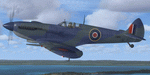
Spitfire IXc EN186 was the personal aircraft of S/L L.C. Wade, an American flying with the RAF. Wade was born in the small farming community of Broaddus, Texas in 1915. He was the second son of Bill and Susan Wade, who named him L.C. (only after the RAF demanded a forename did he call himself Lance Cleo Wade). After the family moved to a farm near Reklaw, Texas in 1922 he worked on the family farm and attended the local school. He was unable to join the US Army Aviation Cadet Program due to a lack of a college education. He began flying at age 17, at Tucson, Arizona. In 1934 at age 19, Wade joined the Civilian Conservation Corps (CCC) in Arizona. He joined the RAF in Canada in December 1940 and trained with No. 52 Operational Training Unit (OTU). Wade was then sent to the British aircraft carrier Ark Royal and flew off her deck in Hawker Hurricane to reinforce the depleted ranks of aircraft on the island of Malta. He was then sent to Egypt as a Hawker Hurricane Mk I pilot in September 1941, and was posted to 33 Squadron. The squadron's mission was to provide close air support for Operation Crusader, the British assault launched on November 18, 1941, against the German Afrika Korps. His first kills were two Fiat CR.42s on 18 November. He attained the rank of "ace" on 24 November 1941. He began flying Hurricane Mk IIs in April 1942, and was awarded the Distinguished Flying Cross (DFC). He had 13 victories as of September 1942. He spent the next several months back in the US on various RAF projects including evaluating some American fighters at Wright Field. He returned to combat as a Flight Commander in 145 Squadron with a Bar to his DFC, flying Supermarine Spitfire Mk Vs. Promoted to squadron leader, he had a busy 60 days, as by the end of April his score was 21, by then flying Spitfire Mk IXs. His squadron moved to Italy, and as a Spitfire VIII pilot he claimed two Focke-Wulf Fw 190s of Schlachtgeschwader 4 on 2 October 1943. His last claims were three FW 190s (again of SG 4) damaged on 3 November. Wade became a wing commander and joined the staff of the Desert Air Force but was there only briefly, as he was killed in a flying accident on 12 January 1944 at Foggia, Italy. In 30 fights for which he made claims he was credited with 23 victories including two shared), one probable, and 13 damaged. He is also credited with one destroyed and five damaged on the ground.
Wing Commander Wade is usually listed with 25 victories but official RAF records show that he had 22 solo victories and half each of two more for a total of 23, not counting one probable. Regardless of whether his score is 25, or 23 victories, he is still the leading American fighter ace to serve exclusively in any foreign air force.
Since he never transferred to the USAAF, or any other American Air service, Wade never got the publicity that other American aces received and thus is more obscure than his peers.
The aircraft depicted in this repaint, EN186, started its active career with 249 sqn on Malta, who used it for high flying reconaissance, and who were responsible for replacing the dark green with Mediterranean Blue. The aircraft was then transferred to Tunisia, where it was the personal aircraft of W/C Gleed of the 244 wing. After his death, it went to L.C. Wade, who scored 5 victories with it in april 1943. He did not apply any codes to it, and referred to it in his logbook as BB, for Blue Bird. He flew it till august 1943, when he changed to flying Spitfire MK VIII JF472
Repaint by Jan Kees Blom, based on the paintkit by RealAir.
| Filename: | Supermarine_Spitfire_MkIX_EN186_Bluebird.zip |
| License: | Freeware |
| Added: | 11th July 2018, 16:54:01 |
| Downloads: | 104 |
| Author: | Jan Kees Blom |
| Size: | 3.59 MB |
| Category: Flight Simulator 2004 - Aircraft Repaints, Textures and Modifications | |
| Grumman F 14B Tomcat 'Jolly Rogers' |
|
File Description:
These are textures ***ONLY*** and are applied to Jeff Dobbing and D.Cattaneo's Grumman F 14B, filename: f14bfs9a.zip; available at http://www.fsfreeware.com/cgi-bin/dcd_a/dcd.cgi I wish to thank these gentlemen for providing us with such a fine model of this aircraft and their kind permission to repaint it. These are 32-bit textures with no mip-maps to preserve image clarity.
These textures are the "hi-viz" paint scheme that the CAG (Commander Air Group), XO's, and show aircraft wear. Basic differences are that the stripes on the fuselage under the cockpit are outlined in yellow as are the tail-fins, and the drop tanks are glossy black and carry the same yellow/black stripes as the fuselage does. Also the fins below the engines are outlined in yellow. Instead of a flat black, they use a glossy black on the black areas of the Tomcat. The yellow/black colors do make for a nice contrast. The significance of the yellow and black colors are a carry-over from the early days of VF-84 and when the "colors" were passed to VF-103 after VF-84 was decommissioned VF-103 "show" aircraft carry the full squadron colors in remembrance of VF-84 and past squadrons that carried the "Jolly Rogers" mantel. They are subtle differences in the paint schemes but have some meaning for the squadrons.
Enjoy! Heather
| Filename: | Grumman_F_14B_Tomcat_Jolly_Rogers.zip |
| License: | Freeware, limited distribution |
| Added: | 29th March 2004, 13:50:29 |
| Downloads: | 2,406 |
| Author: | Heather Sherman (Repaint) |
| Size: | 5.32 MB |
| Category: Flight Simulator X - Missions | |
| SAR...Bimbo, Zula, Dobo |
|
File Description:
Russian Circus " Flying Sagitarius" (ïîëåò Sagitarious ) is visiting
Georgia and its mountain communities. Due to the cold weather, not expected by Yokoliv Burulov,
owner and trapeze swinger of the circus, three of his "stars" had to be taken by truck to a hospital since
their bowels have suffered " Dirruscus-Megra" a common cold water desease in the mountains. The three
ill "stars" are the Elephant "Bimbo"--"Zula" the laughfing Zebra and "Dobo" the great Dansing Russian Brown Bear...
Together these animals are worth around 75,000 Rubles in the Circus Markets.----Now Yokoliv has received
a call that the truck had an accident on the road and the three characters have run into the mountains. Not
wasting time he has asked the nearby Air Force Base for help. General Gustrgy Bonklovsky commander of the base and circus lover, has agreed to provide him with a SAR helicopter that will search the area and find at all cost the Animals....You are called to be the pilot for the mission at hand. Its cold, muggy and for the last three days fog has been lingering all over the mountains.---"this is the life pilot" says General Bonklovsky , as he hands you the search area map with a sardonic smile. You smell the presence of resently drunk Vodka and leave the hut toward the spinning Chopper.---Download MI-8 Helicopter for Mission
| Filename: | SARBimbo_Zula_Dobo.zip |
| License: | Freeware, limited distribution |
| Added: | 28th April 2008, 04:29:52 |
| Downloads: | 1,166 |
| Author: | Gera Godoy Canova |
| Size: | 5.96 MB |
| Category: Flight Simulator X - Aircraft Repaints, Textures and Modifications | |
| B-24 USAAF 489th BG "Sharon D" |
|
File Description:
This Ford-built B-24H was assigned to Lt Col Leon Vance, deputy commander of the 489th BG. It was Vance who had brought the aircraft from the US to Halesworth. The bomber was named after its pilot’s infant daughter Sharon, who had been born in 1942. Lt Col Vance was flying a different aircraft on the 5 June 1944 mission against a German coastal defence complex near Wimereaux, France-a mission in which the latter aircraft was lost, and for which Vance was awarded the Medal of Honor. He was the only B-24 crew member in the Eighth Air Force accorded this distinction whilst flying a mission from the UK. Vance was heading home to recover from combat wounds when he went down on a C-54 Skymaster carrying wounded and crippled veterans over the North Atlantic on 26 July 1944. In October 1946, at the age of four, Sharon Vance travelled via US Army Air Forces transport to Enid, Oklahoma (now home of Vance Air Force Base), for a ceremony in which Maj Gen James P Hodges gave her the Medal of Honor awarded to her father. Today, daughter Sharon Kiernan of San Diego, California, is an Air Force wife, and she helps to keep alive the memory of her father, and of the bomber named after her. The Sharon D retained its nickname throughout the war, and was eventually transferred to the 445th BG. It survived the conflict, and was eventually broken up for scrap.
Repaint by Jan Kees Blom for the AlphaSim 2008 Consolidated B-24 Liberator
| Filename: | B24_USAAF_489th_BG_Sharon_D.zip |
| License: | Freeware |
| Added: | 31st October 2008, 18:18:46 |
| Downloads: | 479 |
| Author: | Jan Kees Blom |
| Size: | 8.27 MB |
| Category: Microsoft Flight Simulator (2020) - Aircraft Repaints, Textures and Modifications | |
| Goodyear FG-1D Corsair VF-17 #29 Lt Kepford |
|
Images related to this file:
File Description:
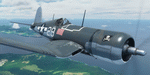
This folder contains a repaint for the FG-1D Corsair by Milviz, in the colors of F4U-1 BuNo 55995 of VF-17, the aircraft flown by Lt (jg) Ira C. Kepford, Bougainville, February 1944. Ira Cassius Kepford was born in Harvey, Illinois, on May 29, 1919, son of George Raymond and Emma McLaughlin Kepford. His family moved to Muskegon, Michigan, shortly after he was born. An all-around athlete at Muskegon High School from 1935-1937, he capped his prep career by being named an All-State back in his senior year. He enrolled at Northwestern University in 1938 to study for a dentistry career.
He enlisted in the U.S. Naval Reserve on August 18, 1941, and was honorably discharged on April 29, 1942, to accept appointment as Aviation Cadet, U.S.N.R. After flight training at the Naval Air Stations, Corpus Christi, Texas, and Miami, Florida, he became a Naval Aviator on November 5, 1942, and was commissioned Ensign, U.S.N.R., with date of rank October 16, 1942.
Detached from Naval Air Station, Miami, Florida, in December 1942, he served with Fighting Squadron 17 in the Pacific War Area until March 1944, where he became the U.S. Navy's leading ace, scoring a record 16 confirmed Japanese planes destroyed. That squadron won the Navy Unit Commendation and he was personally awarded the Navy Cross, a Gold Star in lieu of the second Navy Cross, the Silver Star Medal and the Distinguished Flying Cross.
From March until June he was attached to the Fleet Air, Alameda, Command, and the last six months of that year served with Fighting Squadron 84. In December 1944 he was transferred to the staff of Commander Fleet Air, West Coast, and remained in that assignment throughout the remaining period of hostilities. Repaint by Jan Kees Blom.
| Filename: | Goodyear_FG1D_Corsair_VF17_29_Lt_Kepford.zip |
| License: | Freeware |
| Added: | 4th April 2021, 15:38:23 |
| Downloads: | 63 |
| Author: | Jan Kees Blom |
| Size: | 41.83 MB |
| Category: Prepar3D V1-4 - Aircraft Repaints, Textures and Modifications | |
| Messerschmitt Bf-109E - Yellow ‘1’ Josef Priller |
|
Images related to this file:
File Description:
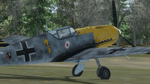
Yellow ‘1’, W.Nr. 5057, was flown by the commander of 6. Staffel JG 51, Josef Priller, and underwent several camouflage color modifications through its career. According to some sources, the initial scheme was composed of RLM 70/71/65. However, it is easier to confirm later variations, when the underside light blue was extended up the sides of the fuselage, and quite high up at that. Later, this color was subdued by the application of irregular squiggles of RLM 02 and 71. Furthermore, the upper surfaces of the wing, originally composed of broken lines, were augmented in a similar manner as the fuselage sides. This was the appearance of the aircraft in the fall of 1940, and as depicted by our profile. At the time, the aircraft also received a yellow nose section and rudder. The extent of the front end yellow coloring is up for speculation. The emblem of II./JG 51 ‘Gott strafe England!’ (God punish England!) shown on the rear of the fuselage, is sprayed on without the usual white background, only with the black border around a black raven with an umbrella, symbolizing Neville Chamberlain. The Staffel marking in the form of the Ace of Hearts subsequently was used on Priller’s later aircraft as a personal marking. The kill marks denoting Priller’s aerial victories on the tail in the form of vertical tabs with dates, partially obscured the Swastika. Beer lover Josef Priller attained 101 aerial victories in 1,307 operational flights between 1939 and 1945.TEXTURES only. Included are textures for a non-Swastika version. Repaint for the Shockwave (A2) Messerschmitt BF 109 for FSX. The aircraft works without issues in P3D. Just copy aircraft the installation folder from FSX to the P3D Simobjects folder.
| Filename: | Messerschmitt_Bf109E__Yellow_1_Josef_Priller.zip |
| License: | Freeware, limited distribution |
| Added: | 22nd March 2019, 04:33:30 |
| Downloads: | 101 |
| Author: | Eberhard Haberkorn / A2A |
| Size: | 75.69 MB |
| Category: Flight Simulator 2002 - Aircraft Repaints, Textures and Modifications | |
| Hellenic Air Force Republic Aviation F-84F Thunderstreak |
|
File Description:
This is one of the first jet age aircrafts served in Hellenic Air Force, almost 50 years ago (!!!). There are three (3) repaint versions of Royal Hellenic Air Force in the zip package: The first one, represents an F-84F, as placed in front of 113rd Wing's main entrance as a "gate guard monument". The aircraft was placed there during early '90ies and the idea was captured by Brigadier General Vlachandonis who used to be the 113rd Wing's commander at that time. The second, shows an F-84F, as it was painted from 1957 to 1967. The specific aircraft used to belong to 339th Sqdr.with a white-blue-white stripe painted close to the nose as a squadron's ID mark. Additionaly, the "Mighty Mouse" official Sqdr's badge was placed on the left part of fuselage, just behind the cockpit. The thrird repaint is representing an F-84F, as it was painted from 1971, until the "retirement" on 1984. The aircraft which is presented into this "VietNam typed" repaint version used to belong to 338th Sqdr. operating from Larisa AB. This "F84F_HAF.zip" package is full compatible with FS2K2 and FS9 too and contains realistic sound made by Angelos Hatzikatakos, new panel made by Nick Karatzides, helpfull checklist and a VERY completed (as always...) flight manual (46 pages) which can be read with Adobe Acrobat. This repaint was based on the original model made by Kazunori Ito. A total NEW flight model ("air" file and aircraft.cfg file) have been created by Nick Karatzides and have been tested hard, to ensure that the aircraft flies as close as possible like a real fighter! This "F84F_HAF.zip" package is for EXPERIENCED FlightSimers and virtual pilots who have a "good feeling" on the stick and do not "kick" the contol stick while flying. The package contains new visual effects, night lighting, fine looking mechanical parts movement, contrails, realistic gears extracting / retracting etc.
| Filename: | Hellenic_Air_Force_Republic_Aviation_F84F_Thunders.zip |
| License: | Freeware |
| Added: | 10th March 2004, 03:59:45 |
| Downloads: | 724 |
| Author: | Nick Karatzides, Angelos Hatzikatakos |
| Size: | 12.35 MB |
| Category: Flight Simulator X - Original Aircraft | |
| B-2A Spirit Stealth Bomber |
|
Images related to this file:
File Description:
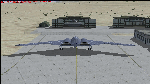
The B-2A Stealth Bomber is the most sophisticated aircraft on the planet. She is essentially a “Flying Wing†platform with no V-Tail, and is controlled by pre-programed flight computers stationed in various positions within the crew cabin and wings. There is one main computer that controls the aircraft, with two redundant back-up computers assigned to it in case of failure. All additional computers are assigned to functions involving flight control, system monitoring, data communications, and radar. Engine and Aerodynamic effects are controlled by these computers which serve several actuators and ailerons, including the spoilerons, which further compensate for the lack of a V-Tail. In theory, and because of these computers, the aircraft is “Stall-Proofâ€. The only way it can stall is if the computers fail. There is no way she can be flown without the computers active. The REAL aircraft does almost everything based on pre-programed data, other than taxi to the runway (although this is also possible to program). Before each flight, the Mission is designed and then assigned to the Mission Flight Box (Portable Computer) which is then carried by the Commander to the aircraft, and the data from the box is “transferred†to the main on-board computers. Because of this, the B-2 cannot be flown until the box is ready for the mission, and pilots cannot simply jump in and fly her, with the exception that the data is transferred via satellite. Everything is pre-planned, and this takes several hours. Once the data is on-board, the taxi can begin. When lined-up on the runway, all the pilot needs to do is push a button or three. Everything else is computer controlled until landing. The aircraft CAN be flown manually with basic data inputs into the main computer systems, but even in that case it is not conventional. If a pilot wants to turn right, he sets the data to turn to a certain degrees of heading. The same with climb and descent, speed increase or decrease. A pilot cannot over-ride the computers in any case, so steep banks, climbs, or descents cannot be forced. There is a lot of space for the two member crew within the cockpit, but there is also a space reserved for one observer. This additional seat is known as “Suicide Position†because there is no ejection seat for that observer. In the event of a mishap, the observer can try to bail-out through the ejection hatches after the pilots, or can try the exit ramp door, or the bomb bay as an exit route. The odds of escape for the observer are very small, but he has a parachute as reassurance. Otherwise, what the crew does during missions is only a guess, since they really don't have to do anything unless an alarm goes off. Since the plane flies so smooth, we can only imagine what sort of things they may dream-up to entertain themselves during a long flight. High altitude flights are conducted at night mainly due to the obvious contrail such a flight will exhibit during the day with such hot engines. The engines are encased in a heat absorbing shield material (still exhaust exists), and the rest of the plane is coated with Radar absorbant material, with the additional low profile effect of the aircraft design itself. If it can be seen by the ground or a fighter, it can be attacked by fighters or the ground. During daytime flight they will stay below the contrail level, and monitor the radar systems in preparations for counter-measures. If a fighter can visually observe them, the fighter may be able to shoot them down with bullets from behind, but not likely with missiles because of the sophisticated counter-measures available. On Radar the aircraft appears the size of a pigeon, until about 8 to 10 miles away, which would be too late to counter from the ground, so most attacks are either done at night or during the day at very low altitude. Upon landing the aircraft is automated down to about 200 feet AGL, when the pilot takes command. All she/he does at this point is allow her to glide down and contact the runway, and retard the engines. Brakes are used to slow, then the computers are turned off, and the pilot can control the throttles, nose gear, and brakes. The Commander watches for obstructions, mainly, and communicates with the tower and ground crew. Everything in this model has been reconfigured to meet realistic standards, without any tricks or flight tuning, and following real world aerodynamic principals and available data, including MOI. The panel requires study before use, but very realistic. The sounds are very authentic. There is no other model offered anywhere that compares to what you have now available in front of you. Please read and study the Readme.txt file within the main folder before attempting to fly this 2.2 Billion Dollar aircraft. Yes, that's correct ... $2,200,000,000 each! The use of this model, and the configuration of such, is designed for educational purposes, and protected by the Free Use Act: (https://www.law.cornell.edu/uscode/text/17/107). The Authors will not approve redistribution for monetary purposes. Original aircraft design by Alphasim; VC Adaptation, panels and gauges by Philippe Wallaert; Sound by Ruggero Osto; REAL WORLD Engine/Aerodynamics, data and effects by Douglas E. Trapp ([email protected]) June 2018
| Filename: | B2A_Spirit_Stealth_Bomber.zip |
| License: | Freeware |
| Added: | 2nd June 2018, 17:16:30 |
| Downloads: | 1,040 |
| Author: | Douglas E. Trapp |
| Size: | 14.81 MB |


© 2001-2026 AVSIM Online
All Rights Reserved
Privacy Policy |