
Where Flight Simulation Enthusiasts Gather from Around the World!
AVSIM Library - Search Results

| Category: Flight Simulator X - Original Aircraft | |
| Savoia Marchetti S.79CS "Sparviero/Corsa-Transatlantico" |

|
Images related to this file:
File Description:
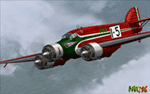
Civilian "CS" (Competizione Sportiva=Sporting Race) versions of the known medium and torpedo bomber Savoia-Marchetti S.79 "Sparviero", deployed by Regia Aeronautica, or Italian Royal Air Force, were successfully flown (w/civil marks) in the "Istres-Damascus-Paris (Lindberg Cup)" 1937 air race, where they ranked the first three places of the final scoreboard. The also "civilian" "T" (Transatlantic) version of the very same S.79 performed exceptionally in the 1938 Atlantic crossing Roma-Dakar-Rio de Janeiro and in 1939 experimental test meant to verify the feasibility of an airline passengers and mail line between Italy and South America for the civilian airlines (Ala Littoria S.A.- Linee Aeree Atlantiche, later called L.A.T.I./Linee Aeree Transcontinentali Italiane) over the routes of Southern Atlantic Ocean.
3 new different GMax models, covering 3 different versions of the civilian S.79 described above and featuring the standard animated parts, such as all flight controls, props pitch and leading-edge slats. Ten (10) different liveries depicting all the S.79CS team which flew the 1937 Istres-Damascus-Paris Race, the 1938 Roma-Rio de Janeiro Expedition and the 1939 Transatlantic Test flight.
This is an adapted FSX version of the original FS9 plane (also available in another separated release).VC only. GMax Models and Skins by Manuele Villa & Italianwings. Installation instructions included. By Manuele Villa/MVG3D, April 2016.
| Filename: | Savoia_Marchetti_S79CS_SparvieroCorsaTransatlantic.zip |
| License: | Freeware |
| Added: | 22nd April 2016, 22:04:21 |
| Downloads: | 709 |
| Author: | Manuele Villa |
| Size: | 86.8 MB |
| Category: Flight Simulator X - Original Aircraft | |
| Avia BH-5 & Avia Bk.11 |
|
File Description:
The plane was constructed according to the type BH-1, the first successful plane produced by the Avia Works. It was an all-wooden two-seat training, sports and messenger plane, which was bigger than BH-1, more solid and more sophisticated, in its aerodynamics and technology. It was designed for flying basic acrobatics. The BH-5 was the first Czechoslovak plane to win an international contest and thus received the King of Belgium‘s Prize and the prize of the Belgian Tourist Aircraft Contest in 1923. The pilot, Zdenìk Lhota, flew to Brussels and back with a layover in Mayence at an average speed of 138 km/h. In 1923 this was a remarkable performance, not only in the sport-plane category. In 1923, the type BH-5 also won the “D“ category in the President of the Republic’s Contest. The Walter NZ-60, a radial five-cylinder engine, was installed in the BH-5 plane; it was the very first and a very successful engine designed by the Walter Company. Based on the results of military tests of the BH-5s, the Ministry of Defense placed an order for a series of slightly improved BH-9, BH-10 and later also BH-11 Avias, which had been successful in many national, as well as international contests and also in record and promotion flights. The BH-5 Avia plane was marked L-BOSA; thanks to this mark, all the planes of this very successful series were nicknamed “boska“. This addon has detailed 3D model and VC, original sounds, real flight dynamics and manual.
| Filename: | Avia_BH5__Avia_Bk11.zip |
| License: | Freeware, limited distribution |
| Added: | 8th December 2007, 23:10:17 |
| Downloads: | 3,730 |
| Author: | Štìpán Obrovský, Czechoslovak Historic Flight www.hictoricflight.cz |
| Size: | 31.66 MB |
| Category: Flight Simulator X - Original Aircraft | |
| B-2A Spirit Stealth Bomber |
|
Images related to this file:
File Description:
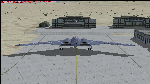
The B-2A Stealth Bomber is the most sophisticated aircraft on the planet. She is essentially a “Flying Wing†platform with no V-Tail, and is controlled by pre-programed flight computers stationed in various positions within the crew cabin and wings. There is one main computer that controls the aircraft, with two redundant back-up computers assigned to it in case of failure. All additional computers are assigned to functions involving flight control, system monitoring, data communications, and radar. Engine and Aerodynamic effects are controlled by these computers which serve several actuators and ailerons, including the spoilerons, which further compensate for the lack of a V-Tail. In theory, and because of these computers, the aircraft is “Stall-Proofâ€. The only way it can stall is if the computers fail. There is no way she can be flown without the computers active. The REAL aircraft does almost everything based on pre-programed data, other than taxi to the runway (although this is also possible to program). Before each flight, the Mission is designed and then assigned to the Mission Flight Box (Portable Computer) which is then carried by the Commander to the aircraft, and the data from the box is “transferred†to the main on-board computers. Because of this, the B-2 cannot be flown until the box is ready for the mission, and pilots cannot simply jump in and fly her, with the exception that the data is transferred via satellite. Everything is pre-planned, and this takes several hours. Once the data is on-board, the taxi can begin. When lined-up on the runway, all the pilot needs to do is push a button or three. Everything else is computer controlled until landing. The aircraft CAN be flown manually with basic data inputs into the main computer systems, but even in that case it is not conventional. If a pilot wants to turn right, he sets the data to turn to a certain degrees of heading. The same with climb and descent, speed increase or decrease. A pilot cannot over-ride the computers in any case, so steep banks, climbs, or descents cannot be forced. There is a lot of space for the two member crew within the cockpit, but there is also a space reserved for one observer. This additional seat is known as “Suicide Position†because there is no ejection seat for that observer. In the event of a mishap, the observer can try to bail-out through the ejection hatches after the pilots, or can try the exit ramp door, or the bomb bay as an exit route. The odds of escape for the observer are very small, but he has a parachute as reassurance. Otherwise, what the crew does during missions is only a guess, since they really don't have to do anything unless an alarm goes off. Since the plane flies so smooth, we can only imagine what sort of things they may dream-up to entertain themselves during a long flight. High altitude flights are conducted at night mainly due to the obvious contrail such a flight will exhibit during the day with such hot engines. The engines are encased in a heat absorbing shield material (still exhaust exists), and the rest of the plane is coated with Radar absorbant material, with the additional low profile effect of the aircraft design itself. If it can be seen by the ground or a fighter, it can be attacked by fighters or the ground. During daytime flight they will stay below the contrail level, and monitor the radar systems in preparations for counter-measures. If a fighter can visually observe them, the fighter may be able to shoot them down with bullets from behind, but not likely with missiles because of the sophisticated counter-measures available. On Radar the aircraft appears the size of a pigeon, until about 8 to 10 miles away, which would be too late to counter from the ground, so most attacks are either done at night or during the day at very low altitude. Upon landing the aircraft is automated down to about 200 feet AGL, when the pilot takes command. All she/he does at this point is allow her to glide down and contact the runway, and retard the engines. Brakes are used to slow, then the computers are turned off, and the pilot can control the throttles, nose gear, and brakes. The Commander watches for obstructions, mainly, and communicates with the tower and ground crew. Everything in this model has been reconfigured to meet realistic standards, without any tricks or flight tuning, and following real world aerodynamic principals and available data, including MOI. The panel requires study before use, but very realistic. The sounds are very authentic. There is no other model offered anywhere that compares to what you have now available in front of you. Please read and study the Readme.txt file within the main folder before attempting to fly this 2.2 Billion Dollar aircraft. Yes, that's correct ... $2,200,000,000 each! The use of this model, and the configuration of such, is designed for educational purposes, and protected by the Free Use Act: (https://www.law.cornell.edu/uscode/text/17/107). The Authors will not approve redistribution for monetary purposes. Original aircraft design by Alphasim; VC Adaptation, panels and gauges by Philippe Wallaert; Sound by Ruggero Osto; REAL WORLD Engine/Aerodynamics, data and effects by Douglas E. Trapp ([email protected]) June 2018
| Filename: | B2A_Spirit_Stealth_Bomber.zip |
| License: | Freeware |
| Added: | 2nd June 2018, 17:16:30 |
| Downloads: | 1,040 |
| Author: | Douglas E. Trapp |
| Size: | 14.81 MB |


© 2001-2026 AVSIM Online
All Rights Reserved
Privacy Policy |